Tidal deformations of general-relativistic multifluid compact stars

By: Ethan Carlier, Nicolas Chamel
Over the past decade, gravitational-wave astronomy has opened a new window onto the extreme states of matter inside compact stars. At some point during the inspiral of a binary system, each star starts to experience adiabatic tides, characterized by tidal deformabilities. The dominant tidal deformability, first measured with the GW170817 event, has already constrained the dense-matter equation of state. With the advent of third-generation det... more
Over the past decade, gravitational-wave astronomy has opened a new window onto the extreme states of matter inside compact stars. At some point during the inspiral of a binary system, each star starts to experience adiabatic tides, characterized by tidal deformabilities. The dominant tidal deformability, first measured with the GW170817 event, has already constrained the dense-matter equation of state. With the advent of third-generation detectors, tidal deformabilities are expected to be inferred with much higher precision, potentially revealing subleading tidal contributions. This motivates the development of more accurate compact-star models that incorporate richer microphysics. With this in mind, we move beyond the commonly adopted perfect-fluid approximation and model compact stars through a multifluid framework. In this work, we present the fully general-relativistic description of adiabatic tidal deformations of compact stars composed of an arbitrary number of interacting fluids, using Carter's multifluid variational formalism. A distinctive feature of this approach is the presence of nondissipative mutual entrainment between fluid species. We derive the hydrostatic equilibrium equations for multifluid configurations, along with the perturbed equations governing stationary gravitoelectric and gravitomagnetic tidal responses of arbitrary order. We then investigate how entrainment modifies the corresponding tidal deformabilities. Using an analytical representation of the multifluid equation of state, we show that entrainment leaves adiabatic tidal responses unchanged and therefore produces no measurable effect on the gravitational-wave signal emitted during the inspiral long before the excitation of internal mode resonances. We subsequently discuss two specific applications: superfluid neutron stars and dark matter admixed compact stars. less
QTAM: QTransform Amplitude Modulation

By: Lorenzo Asprea, Francesco Sarandrea, Alessio Romano, Jacob Lange, Federica Legger, Sara Vallero
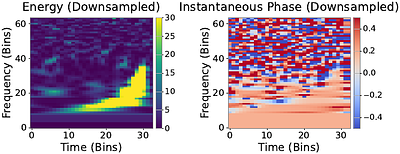
We present Q-Transform Amplitude Modulation (QTAM), a novel, fully invertible implementation of the Constant-Q Transform algorithm, designed to enable robust signal denoising and the disentanglement of overlapping transient events in current and next generation gravitational wave (GW) observatories. Time-frequency (TF) analysis faces a fundamental dichotomy: critically sampled transforms are computationally efficient but lack time-shift invar... more
We present Q-Transform Amplitude Modulation (QTAM), a novel, fully invertible implementation of the Constant-Q Transform algorithm, designed to enable robust signal denoising and the disentanglement of overlapping transient events in current and next generation gravitational wave (GW) observatories. Time-frequency (TF) analysis faces a fundamental dichotomy: critically sampled transforms are computationally efficient but lack time-shift invariance, limiting their efficacy for robust pattern recognition and Deep Learning applications. While alternative approaches such as the Dual-Tree Complex Wavelet Transform provide efficient approximate shift-invariance, their wavelet constructions remain tied to dyadic scale frequency tilings that are poorly matched to the simultaneous representation of GW chirps and instrumental glitches. Conversely, overcomplete transforms provide the necessary shift-invariance and tunable frequency resolution, but their implementations generate highly redundant data volumes that are prohibitive for low-latency (LL) processing. Furthermore, standard attempts to compress these dense representations rely on lossy interpolation, destroying the phase coherence required to reconstruct the signal. QTAM bridges this gap by employing a methodology inspired by Amplitude Modulation radio broadcasting. By modeling the Q-transform output as a slowly varying complex envelope carried by a deterministic high-frequency term, we achieve lossless data decimation via spectral shifting to baseband. We demonstrate that QTAM is linear and fully invertible, allowing exact reconstruction of the original signal with machine precision while retaining the shift-invariance of dense spectrograms. Leveraging native GPU acceleration, QTAM enables TF pipelines to operate within LL O(1s) bounds. We validate the method's potential for denoising and disentanglement on GW data and signal injections. less
Connection Between the Shadow Radius and Quasinormal Frequencies for Black Holes in STVG with Perfect Fluid Dark Matter

By: Ziqiang Cai, Zhi Li, Zhenglong Ban, Qi-Qi Liang, Zheng-Wen Long
We investigate the connection between black hole shadow and quasinormal mode (QNM) spectra in the context of scalar--tensor--vector gravity (STVG) coupled to perfect fluid dark matter (PFDM), characterized by the MOG parameter $α$ and the dark matter intensity $λ$. Employing complementary methods -- namely the sixth-order WKB approximation, Padé resummation, and time-domain numerical integration -- we compute QNM frequencies for scalar ($s=0$... more
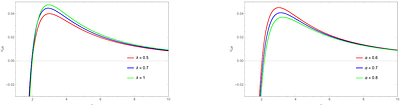
We investigate the connection between black hole shadow and quasinormal mode (QNM) spectra in the context of scalar--tensor--vector gravity (STVG) coupled to perfect fluid dark matter (PFDM), characterized by the MOG parameter $α$ and the dark matter intensity $λ$. Employing complementary methods -- namely the sixth-order WKB approximation, Padé resummation, and time-domain numerical integration -- we compute QNM frequencies for scalar ($s=0$), electromagnetic ($s=1$), and axial gravitational ($s=2$) perturbations. Both the real part of the QNM frequencies and the peak height of the effective potential display a consistent parametric dependence: they increase with $λ$ yet decrease with growing $α$. In the eikonal limit ($l \gg 1$), we derive an exact analytical link between the shadow radius $R_{\mathrm{sh}}$ and the QNM frequency $ω_R$. Noting that $R_{\mathrm{sh}}$ is determined by the critical impact parameter $b_c = r_{\mathrm{ph}}/\sqrt{f(r_{\mathrm{ph}})}$, while $ω_R = Ωl$ with photon angular velocity $Ω= \sqrt{f(r_{\mathrm{ph}})}/r_{\mathrm{ph}}$, we obtain the precise relation $ω_R = l / b_c$, identifying $R_{\mathrm{sh}} \equiv b_c$ for an asymptotically flat observer. This prediction is robustly validated by numerical results across all three computational approaches at large multipole numbers. Our findings reveal that the black hole shadow and gravitational ringdown are not independent phenomena, but dual observational signatures of the same underlying structure -- the unstable photon orbit -- thereby offering a unified multi-messenger framework to simultaneously constrain modified gravity and dark matter in the strong-field regime. less
8 SciCasts by .
Repetitive Penrose Process in Kerr-Taub-NUT black hole spacetime

By: Mirzabek Alloqulov, Bobomurat Ahmedov, Chengxun Yuan
In this article, we study the repetitive Penrose process for the Kerr-Taub-NUT black hole (BH). First of all, we briefly review the spacetime of the Kerr-Taub-NUT BH, including horizon and ergosphere structures. The results indicate that the event horizon and ergosphere radii increase under the influence of the gravitomagnetic charge $l$. Subsequently, we find by using the irreducible mass of the BH that the extractable energy decreases with ... more
In this article, we study the repetitive Penrose process for the Kerr-Taub-NUT black hole (BH). First of all, we briefly review the spacetime of the Kerr-Taub-NUT BH, including horizon and ergosphere structures. The results indicate that the event horizon and ergosphere radii increase under the influence of the gravitomagnetic charge $l$. Subsequently, we find by using the irreducible mass of the BH that the extractable energy decreases with the rise of the gravitomagnetic charge. We then turn to the repetitive Penrose process by writing the conservation laws and setting the corresponding iterative stopping conditions. Furthermore, we numerically calculate the change in the BH's parameters, along with the corresponding quantities of the repetitive Penrose process, for each iteration. less
Exact lambdavacuum solutions in higher dimensions

By: I. A. Sarmiento-Alvarado, P. Wiederhold, T. Matos
In this work, we obtain exact solutions to the $(n+2)$-dimensional Einstein Field Equations with a non-zero cosmological constant for $n > 1$. These solutions depend on a set $\{ A_a, a=1,2,\ldots , m \}$ of pairwise commuting constant matrices in $\mathfrak{sl} ( n, \mathbb{R} )$ and on a constant matrix $g_0$ in $\mathcal{I} (\{ A_a, a=1,\ldots , m \})$, determined in previous work. Different choices of $\{ A_a, a=1,\ldots , m \}$ and $... more
In this work, we obtain exact solutions to the $(n+2)$-dimensional Einstein Field Equations with a non-zero cosmological constant for $n > 1$. These solutions depend on a set $\{ A_a, a=1,2,\ldots , m \}$ of pairwise commuting constant matrices in $\mathfrak{sl} ( n, \mathbb{R} )$ and on a constant matrix $g_0$ in $\mathcal{I} (\{ A_a, a=1,\ldots , m \})$, determined in previous work. Different choices of $\{ A_a, a=1,\ldots , m \}$ and $g_0$ correspond to different solutions. As examples, we show how to obtain the de Sitter metric, the Anti-de Sitter metric, the Birmingham metric, the Nariai metric and the Anti-Nariai metric in higher dimensions. The generalized Nariai and Anti-Nariai solutions are direct topological products of $AdS_{\frac{n}{2} + 1} \times H^{\frac{n}{2} + 1}$, $dS_{\frac{n}{2} + 1} \times S^{\frac{n}{2} + 1}$, $AdS_2 \times H^n$, $AdS_n \times H^2$, $dS_2 \times S^n$ and $dS_n \times S^2$. In addition, we study a solution in the context of cosmology. less
Quasinormal modes and AdS/CFT correspondence of a rotating BTZ-like black hole in the Einstein-bumblebee gravity

By: Fangli Quan, Zhong-Wu Xia, Rui Ding, Qiyuan Pan, Jiliang Jing
We obtain exact expressions for the quasinormal modes (QNMs) of the massive scalar, fermionic and vector perturbations around a rotating BTZ-like black hole in the Einstein-bumblebee gravity. We find that the Lorentz symmetry breaking (LSB) parameter $\ell$ leaves its imprint only on the imaginary parts of the quasinormal frequencies and the corresponding perturbation field decays more slowly for a larger $\ell$, except for the left-moving qu... more
We obtain exact expressions for the quasinormal modes (QNMs) of the massive scalar, fermionic and vector perturbations around a rotating BTZ-like black hole in the Einstein-bumblebee gravity. We find that the Lorentz symmetry breaking (LSB) parameter $\ell$ leaves its imprint only on the imaginary parts of the quasinormal frequencies and the corresponding perturbation field decays more slowly for a larger $\ell$, except for the left-moving quasinormal frequencies $ω_L$ with positive mass and the right-moving ones $ω_R$ with negative mass for the fundamental modes under the vector perturbation where the imaginary parts are independent of $\ell$. We also note that, regardless of the kind of perturbations, the real parts depend only on the angular quantum number, which are the same as those in the standard BTZ black hole. Furthermore, we investigate the AdS/CFT correspondence from the QNMs and observe that the expected universal relation for the left and right conformal weights ($h_L,h_R$) of the boundary operators dual to various fields still holds even for the BTZ-like black hole in the Einstein-bumblebee gravity. These results strongly support the AdS/CFT correspondence and could help us better understand the Einstein-bumblebee gravity with the Lorentz symmetry violation. less
8 SciCasts by .
Sign Errors in "The Four Laws of Black Hole Mechanics"

By: Richard P. Behiel

In 1973, Bardeen, Cater, and Hawking published "The Four Laws of Black Hole Mechanics", establishing the mathematical framework that would later be understood as the thermodynamics of black holes. Central to the paper is equation (33), which writes the variation of the total energy-momentum integral in terms of physically meaningful quantities: angular momentum, particle number, and entropy. Equation (33) feeds into the differential mass form... more
In 1973, Bardeen, Cater, and Hawking published "The Four Laws of Black Hole Mechanics", establishing the mathematical framework that would later be understood as the thermodynamics of black holes. Central to the paper is equation (33), which writes the variation of the total energy-momentum integral in terms of physically meaningful quantities: angular momentum, particle number, and entropy. Equation (33) feeds into the differential mass formula, equation (34), which is the first law of black hole mechanics. This note identifies two compensating sign errors in the BCH paper. The first error, demonstrated by a derivation from equation (32), is that equations (33) and (34) should carry minus signs rather than plus signs on the last two integrals, those involving the redshifted chemical potential and the redshifted temperature. he second error is that the definitions of total particle number N and total entropy S given after equation (20) are missing minus signs that are required for these quantities to be positive. These two errors cancel, in that reversing the signs in the definitions of N and S to ensure positive quantities makes equations (33) and (34) correct. All conclusions of the BCH paper remain valid. This note is intended merely as a guide for readers who, in working through the derivation step by step, might otherwise be puzzled by the sign discrepancies. Numbered equations refer to the BCH paper; lettered equations are introduced in this note. less
Suppression of Trapped Surface Formation by Quantum Gravitational Effects

By: Ram Brustein, A. J. M. Medved, Hagar Meir
Classical general relativity predicts that a contracting, spherically symmetric matter system with a large-enough mass will result in the formation of a trapped region whose outer boundary is an apparent horizon where the gravitational redshift diverges. The incompleteness theorems then lead to the conclusion that the outcome of the collapse is the singular geometry of a Schwarzschild black hole. Both analyses rely on solving Einstein's equat... more
Classical general relativity predicts that a contracting, spherically symmetric matter system with a large-enough mass will result in the formation of a trapped region whose outer boundary is an apparent horizon where the gravitational redshift diverges. The incompleteness theorems then lead to the conclusion that the outcome of the collapse is the singular geometry of a Schwarzschild black hole. Both analyses rely on solving Einstein's equations, a set of partial differential equations, valid in the limit that the Schwarzschild radius is finite but the Planck length is set to zero, so that quantum fluctuations of the geometry are completely absent. Here, we keep both parameters finite, allowing the geometry to fluctuate quantum mechanically, and take the limit of vanishing Planck length only at the end. Expressing the geometry of a spherically symmetric, collapsing, thin shell of matter in terms of an effective quantum field theory in 1+1 dimensions, we show, using the standard techniques of quantum field theory in curved spacetime, that the production of particles as the shell approaches its would-be horizon is finite in the limit of vanishing Planck length. The total number of produced quanta of the gravitational field scales as the Bekenstein-Hawking entropy, while their total energy scales as the mass of the shell. Importantly, the quantum expectation value of the product of the scalar expansion parameters for the associated null vectors is never vanishing. The conclusion is that an apparent horizon is not formed even when the shell has reached its gravitational radius. As the collapse continues, the classical Schwarzschild geometry can no longer be used to describe the shell's exterior geometry. This provides the sought-after loophole that is needed to explain how astrophysical black holes could be compact objects that are regular and horizonless. less
Testing the strong equivalence principle with multimessenger binary neutron star mergers

By: Jie Zhu, Hanlin Song, Zhenwei Lyu, Hao Li, Peixiang Ji, Jun-Chen Wang, Haobo Yan, Bo-Qiang Ma
The constancy of the gravitational constant $G$ is a cornerstone of the strong equivalence principle and of general relativity, yet its possible temporal variation remains a key target in tests of fundamental physics. Gravitational-wave (GW) astronomy, especially when combined with electromagnetic observations, provides an unprecedented new opportunity to probe this principle in the strong-field and dynamical regime. In this work, we develop ... more
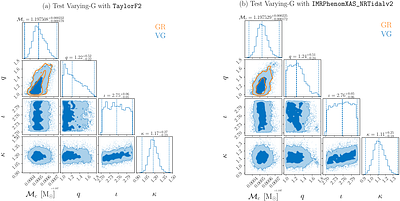
The constancy of the gravitational constant $G$ is a cornerstone of the strong equivalence principle and of general relativity, yet its possible temporal variation remains a key target in tests of fundamental physics. Gravitational-wave (GW) astronomy, especially when combined with electromagnetic observations, provides an unprecedented new opportunity to probe this principle in the strong-field and dynamical regime. In this work, we develop a GW waveform model with a slowly varying gravitational constant, incorporating its effects both on compact binary dynamics and GW propagation in an expanding universe. Applying this framework to the binary neutron star merger GW170817, together with independent electromagnetic constraints on the luminosity distance, sky localization and binary inclination from GRB 170817A, we perform a joint Bayesian analysis that disentangles varying-$G$ effects from astrophysical degeneracies. We find no evidence for a temporal variation of the gravitational constant, and constrain its fractional time derivative to $\dot{G}/G \in [-3.36 \times 10^{-9}, 5.34\times10^{-10}]~{\rm yr^{-1}}$, representing the most stringent bounds obtained to date from real GW observations. Our results demonstrate the power of multi-messenger astronomy as a precision probe of the strong equivalence principle in the relativistic regime. less
Thermodynamic, Optical, and Orbital Signatures of Regular Asymptotically Flat Black Holes in Quasi-Topological Gravity

By: Zainab Malik

This study provides an analytic and numerical characterization of a class of regular, asymptotically flat black holes described by a deformed static spherical metric. The model is grounded in a four-dimensional non-polynomial quasi-topological framework in which higher-curvature corrections remain dynamically nontrivial while the static spherical sector retains a reduced-order structure, enabling tractable black-hole solutions with regular co... more
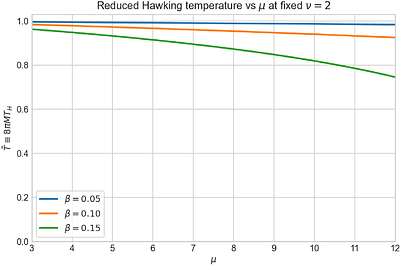
This study provides an analytic and numerical characterization of a class of regular, asymptotically flat black holes described by a deformed static spherical metric. The model is grounded in a four-dimensional non-polynomial quasi-topological framework in which higher-curvature corrections remain dynamically nontrivial while the static spherical sector retains a reduced-order structure, enabling tractable black-hole solutions with regular cores. Starting from the existence conditions of horizons and regularity, the allowed parameter domain and the extremal bound are derived. Hawking temperature, shadow radius, photon-ring Lyapunov exponent, and ISCO binding efficiency are then analyzed across the physically allowed parameter space. We further extend the analysis to Novikov--Thorne thin-disk accretion by deriving the flux kernel, effective-temperature profile, and bolometric luminosity scaling, and by providing representative numerical datasets for these quantities. A coherent trend emerges: increasing the deformation parameter drives the solution away from Schwarzschild behavior, reducing temperature, shadow size, and photon-orbit instability rate while enhancing orbital binding efficiency and accretion luminosity; increasing the exponent $ν$ suppresses deformation effects and restores Schwarzschild-like observables. These results provide a compact phenomenological map linking horizon structure, thermodynamics, optical signatures, dynamical instability, and thin-disk accretion diagnostics in this regular black-hole family. less
Phase Structure of Scalarized Black Holes in Einstein-Scalar-Gauss-Bonnet Gravity

By: Carlos Herdeiro, Hyat Huang, Jutta Kunz, Meng-Yun Lai, Eugen Radu, De-Cheng Zou
We revisit scalarized black holes in Einstein-scalar-Gauss-Bonnet gravity and analyze the thermodynamic phase transition between the Schwarzschild solution of general relativity and scalarized black holes. Restricting to spherically symmetric configurations, we investigate several classes of scalar-Gauss-Bonnet coupling functions. For the simplest quadratic coupling that triggers spontaneous scalarization, the scalarized solutions are thermod... more
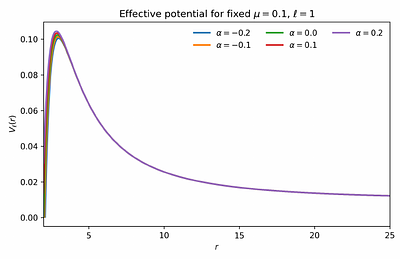
We revisit scalarized black holes in Einstein-scalar-Gauss-Bonnet gravity and analyze the thermodynamic phase transition between the Schwarzschild solution of general relativity and scalarized black holes. Restricting to spherically symmetric configurations, we investigate several classes of scalar-Gauss-Bonnet coupling functions. For the simplest quadratic coupling that triggers spontaneous scalarization, the scalarized solutions are thermodynamically disfavored and no phase transition occurs. For an exponential coupling, the phase structure depends strongly on the coupling parameter, allowing for the absence of a transition, a continuous second-order transition, or a discontinuous first-order transition. For couplings leading to purely nonlinear scalarization, we find either a first-order transition or no transition. These results reveal a rich phase structure of scalarized black holes controlled by the scalar-Gauss-Bonnet coupling. less
Quasinormal Modes of a Massive Scalar Field in 4D Einstein--Gauss--Bonnet Black Hole Spacetimes

By: Bekir Can Lütfüoğlu
We analyze quasinormal modes, grey-body factors, and absorption cross-sections of a massive scalar field in four-dimensional Einstein--Gauss--Bonnet black-hole spacetimes within a stability-constrained coupling window. High-order WKB-Padé spectra show that increasing field mass typically reduces damping and drives the system toward long-lived, quasi-resonant behavior. The scattering sector follows the same potential-barrier physics: larger ef... more
We analyze quasinormal modes, grey-body factors, and absorption cross-sections of a massive scalar field in four-dimensional Einstein--Gauss--Bonnet black-hole spacetimes within a stability-constrained coupling window. High-order WKB-Padé spectra show that increasing field mass typically reduces damping and drives the system toward long-lived, quasi-resonant behavior. The scattering sector follows the same potential-barrier physics: larger effective barriers suppress transmission and low-frequency absorption, while the Gauss--Bonnet coupling has a comparatively mild impact over the stable range. These results provide a compact baseline for massive-field spectroscopy in higher-curvature black-hole backgrounds. less
Testing Dark Energy with Black Hole Ringdown

By: Laurens Smulders, Johannes Noller, Sergi Sirera
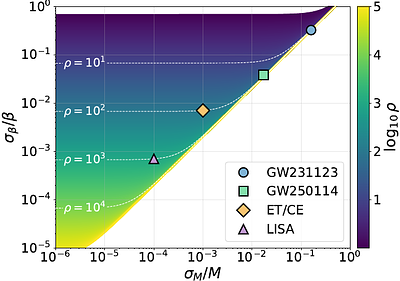
We show that dynamical dark energy theories can imprint $O(1)$ modifications on the quasi-normal mode (QNM) spectrum characterising black hole ringdown. The time dependence of dynamical dark energy naturally gives rise to cosmological 'hair' around a black hole. Taking the cubic Galileon as a concrete example, which admits the only known stable solution of this kind, we parametrically connect the cosmological and black hole regimes, derive th... more
We show that dynamical dark energy theories can imprint $O(1)$ modifications on the quasi-normal mode (QNM) spectrum characterising black hole ringdown. The time dependence of dynamical dark energy naturally gives rise to cosmological 'hair' around a black hole. Taking the cubic Galileon as a concrete example, which admits the only known stable solution of this kind, we parametrically connect the cosmological and black hole regimes, derive the induced QNM shifts and forecast the resulting dark energy constraints. We find that the dark energy field profile can be constrained with an accuracy of up to $10^{-2}$ for LVK and $10^{-4}$ for LISA. less
A rotating GUP black hole: metric, shadow, and bounds on quantum parameters

By: Federica Fragomeno, Samantha Hergott, Saeed Rastgoo, Evan Vienneau
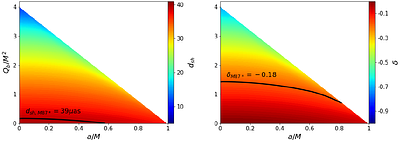
Recently, for the first time, a metric of a static spherically symmetric generalized uncertainty inspired quantum black hole was derived. We apply the modified Newman-Janis algorithm to this metric and derive its rotating counterpart. We show that this metric has all the correct limits, while due to Newman-Janis side effects, the singularity which was resolved in the static case, is introduced back into the model. However, the slowly-rotating... more
Recently, for the first time, a metric of a static spherically symmetric generalized uncertainty inspired quantum black hole was derived. We apply the modified Newman-Janis algorithm to this metric and derive its rotating counterpart. We show that this metric has all the correct limits, while due to Newman-Janis side effects, the singularity which was resolved in the static case, is introduced back into the model. However, the slowly-rotating limit of this black hole is singularity-free. Furthermore, we show that the presence of quantum parameters modifies the location of the horizons, temperature, and entropy of the black hole, and allows the existence of naked singularities even if the ratio of the spin parameter to mass of the black hole is less than unity. Finally, by computing the shadow parameters of this black hole and comparing them with data from the Event Horizon Telescope for both M87* and Sgr A*, we set bounds on one of the quantum parameters of the model, and show that there is a limit on the angular momentum of M87* if this model is valid. less
Virtual absorption modes of Schwarzschild-de Sitter spacetimes in semi-open systems

By: Liang-Bi Wu, Yu-Sen Zhou, Zhe Yu, Ming-Fei Jia, Li-Ming Cao
We present a study of virtual absorption modes (VAMs) in Schwarzschild-de Sitter (SdS) spacetime under semi-open boundary conditions, where the VAMs correspond to total transmission modes (TTMs) with the reflection amplitude being vanished. Our numerical analysis reveals that as the reflectivity $|\mathcal{K}|$ decreases, the VAM spectra migrate systematically toward regions of less negative imaginary parts, with each overtone exhibiting a cr... more
We present a study of virtual absorption modes (VAMs) in Schwarzschild-de Sitter (SdS) spacetime under semi-open boundary conditions, where the VAMs correspond to total transmission modes (TTMs) with the reflection amplitude being vanished. Our numerical analysis reveals that as the reflectivity $|\mathcal{K}|$ decreases, the VAM spectra migrate systematically toward regions of less negative imaginary parts, with each overtone exhibiting a critical reflectivity at which $\text{Im}(ω_{\text{VAM}})=0$. Using simulations based on spectral collocation methods, it is demonstrated that excitation precisely at a VAM spectrum leads to coherent perfect absorption (CPA). These results establish VAMs as the spectrum signatures of CPA for exotic compact objects (ECOs). less
Spontaneous scalarization of neutron stars in teleparallel gravity with derivative torsional coupling

By: Youcef Kehal, Khireddine Nouicer

We study neutron star configurations in a teleparallel gravity model featuring a scalar field coupled to both matter and torsion. In the Einstein frame, the theory includes a derivative coupling between the scalar field and the torsion vector, together with a conformal matter coupling \(A(φ)=\exp(βφ^{2}/2)\). Static and slowly rotating neutron-star solutions are constructed for realistic equations of state, focusing on the APR and MS1 equatio... more
We study neutron star configurations in a teleparallel gravity model featuring a scalar field coupled to both matter and torsion. In the Einstein frame, the theory includes a derivative coupling between the scalar field and the torsion vector, together with a conformal matter coupling \(A(φ)=\exp(βφ^{2}/2)\). Static and slowly rotating neutron-star solutions are constructed for realistic equations of state, focusing on the APR and MS1 equations of state. Scalarized solutions appear only within a finite range of central densities and correspond to localized deviations from the general-relativistic mass--radius and mass--central-density relations. The onset and extent of scalarization depend on the equation of state and on the strength of the derivative torsional interaction, which can either enhance or suppress scalarization relative to the general-relativistic scalarized branch. At high central densities, scalarization is quenched and the solutions approach the general-relativistic limit, remaining bounded even for strong torsional couplings. No scalarized solutions are found in the absence of matter coupling (\(β=0\)). The normalized scalar charge follows trends consistent with the global mass relations, indicating an intermediate scalarized regime suppressed at high compactness. For slowly rotating stars, the moment of inertia depends systematically on the torsional coupling and the equation of state, with stiffer equations yielding larger values. These results highlight the potential of neutron-star radius and rotational measurements to test teleparallel scalarization scenarios. less