Thermodynamic, Optical, and Orbital Signatures of Regular Asymptotically Flat Black Holes in Quasi-Topological Gravity

Thermodynamic, Optical, and Orbital Signatures of Regular Asymptotically Flat Black Holes in Quasi-Topological Gravity
Zainab Malik
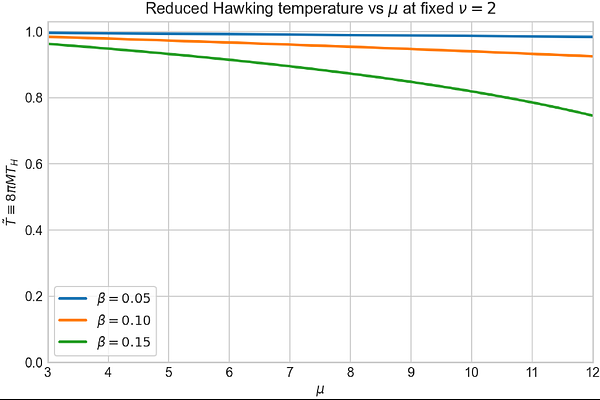
AbstractThis study provides an analytic and numerical characterization of a class of regular, asymptotically flat black holes described by a deformed static spherical metric. The model is grounded in a four-dimensional non-polynomial quasi-topological framework in which higher-curvature corrections remain dynamically nontrivial while the static spherical sector retains a reduced-order structure, enabling tractable black-hole solutions with regular cores. Starting from the existence conditions of horizons and regularity, the allowed parameter domain and the extremal bound are derived. Hawking temperature, shadow radius, photon-ring Lyapunov exponent, and ISCO binding efficiency are then analyzed across the physically allowed parameter space. We further extend the analysis to Novikov--Thorne thin-disk accretion by deriving the flux kernel, effective-temperature profile, and bolometric luminosity scaling, and by providing representative numerical datasets for these quantities. A coherent trend emerges: increasing the deformation parameter drives the solution away from Schwarzschild behavior, reducing temperature, shadow size, and photon-orbit instability rate while enhancing orbital binding efficiency and accretion luminosity; increasing the exponent $ν$ suppresses deformation effects and restores Schwarzschild-like observables. These results provide a compact phenomenological map linking horizon structure, thermodynamics, optical signatures, dynamical instability, and thin-disk accretion diagnostics in this regular black-hole family.