QTAM: QTransform Amplitude Modulation

QTAM: QTransform Amplitude Modulation
Lorenzo Asprea, Francesco Sarandrea, Alessio Romano, Jacob Lange, Federica Legger, Sara Vallero
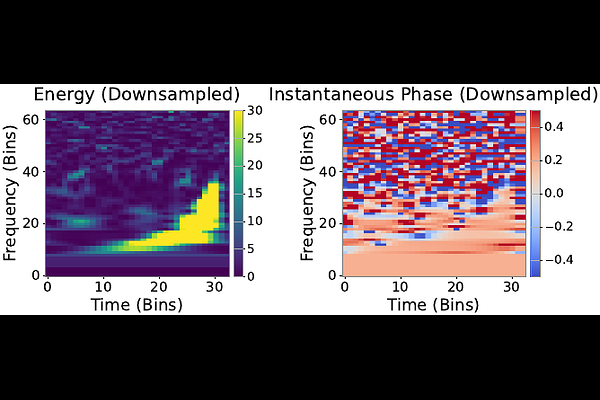
AbstractWe present Q-Transform Amplitude Modulation (QTAM), a novel, fully invertible implementation of the Constant-Q Transform algorithm, designed to enable robust signal denoising and the disentanglement of overlapping transient events in current and next generation gravitational wave (GW) observatories. Time-frequency (TF) analysis faces a fundamental dichotomy: critically sampled transforms are computationally efficient but lack time-shift invariance, limiting their efficacy for robust pattern recognition and Deep Learning applications. While alternative approaches such as the Dual-Tree Complex Wavelet Transform provide efficient approximate shift-invariance, their wavelet constructions remain tied to dyadic scale frequency tilings that are poorly matched to the simultaneous representation of GW chirps and instrumental glitches. Conversely, overcomplete transforms provide the necessary shift-invariance and tunable frequency resolution, but their implementations generate highly redundant data volumes that are prohibitive for low-latency (LL) processing. Furthermore, standard attempts to compress these dense representations rely on lossy interpolation, destroying the phase coherence required to reconstruct the signal. QTAM bridges this gap by employing a methodology inspired by Amplitude Modulation radio broadcasting. By modeling the Q-transform output as a slowly varying complex envelope carried by a deterministic high-frequency term, we achieve lossless data decimation via spectral shifting to baseband. We demonstrate that QTAM is linear and fully invertible, allowing exact reconstruction of the original signal with machine precision while retaining the shift-invariance of dense spectrograms. Leveraging native GPU acceleration, QTAM enables TF pipelines to operate within LL O(1s) bounds. We validate the method's potential for denoising and disentanglement on GW data and signal injections.