By: Youcef Kehal, Khireddine Nouicer
We study neutron star configurations in a teleparallel gravity model featuring a scalar field coupled to both matter and torsion. In the Einstein frame, the theory includes a derivative coupling between the scalar field and the torsion vector, together with a conformal matter coupling \(A(φ)=\exp(βφ^{2}/2)\). Static and slowly rotating neutron-star solutions are constructed for realistic equations of state, focusing on the APR and MS1 equatio... more
We study neutron star configurations in a teleparallel gravity model featuring a scalar field coupled to both matter and torsion. In the Einstein frame, the theory includes a derivative coupling between the scalar field and the torsion vector, together with a conformal matter coupling \(A(φ)=\exp(βφ^{2}/2)\). Static and slowly rotating neutron-star solutions are constructed for realistic equations of state, focusing on the APR and MS1 equations of state. Scalarized solutions appear only within a finite range of central densities and correspond to localized deviations from the general-relativistic mass--radius and mass--central-density relations. The onset and extent of scalarization depend on the equation of state and on the strength of the derivative torsional interaction, which can either enhance or suppress scalarization relative to the general-relativistic scalarized branch. At high central densities, scalarization is quenched and the solutions approach the general-relativistic limit, remaining bounded even for strong torsional couplings. No scalarized solutions are found in the absence of matter coupling (\(β=0\)). The normalized scalar charge follows trends consistent with the global mass relations, indicating an intermediate scalarized regime suppressed at high compactness. For slowly rotating stars, the moment of inertia depends systematically on the torsional coupling and the equation of state, with stiffer equations yielding larger values. These results highlight the potential of neutron-star radius and rotational measurements to test teleparallel scalarization scenarios. less
By: Chengsheng Mu, Shuxun Tian, Shuo Cao, Zong-Hong Zhu
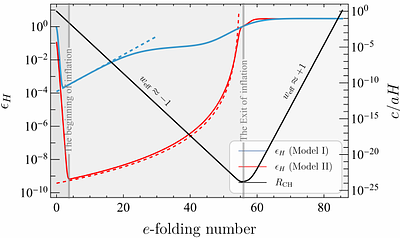
Vacuum energy, a prediction of quantum field theory, manifests itself as a cosmological constant in general relativity. In this Letter, we propose a novel inflationary scenario driven by a bare cosmological constant $Λ$, which terminates naturally through a self-tuning mechanism. Within Fab-Four gravity, self-tuning destabilizes the de Sitter state and drives the system toward a stiff-fluid attractor, thereby yielding a graceful exit. We cons... more
Vacuum energy, a prediction of quantum field theory, manifests itself as a cosmological constant in general relativity. In this Letter, we propose a novel inflationary scenario driven by a bare cosmological constant $Λ$, which terminates naturally through a self-tuning mechanism. Within Fab-Four gravity, self-tuning destabilizes the de Sitter state and drives the system toward a stiff-fluid attractor, thereby yielding a graceful exit. We construct two explicit models in which the slow-roll parameter evolves exponentially or as a power law. We show that the latter model, derived from center-manifold dynamics, significantly relaxes the required tuning of initial conditions. Our results establish, for the first time, that bare-vacuum-energy inflation with natural termination constitutes a viable dynamical possibility. less
By: Andrea Nützi
We show that to every small and decaying solution of the linearized constraint equations about Minkowski spacetime, one can add a quadratically small correction to obtain a solution of the full constraint equations. Near spacelike infinity, the correction is given by Kerr black hole initial data, up to a term that decays faster than the linearized solution, and that has Schwartz decay if the linearized solution has Schwartz decay. Using a rec... more
We show that to every small and decaying solution of the linearized constraint equations about Minkowski spacetime, one can add a quadratically small correction to obtain a solution of the full constraint equations. Near spacelike infinity, the correction is given by Kerr black hole initial data, up to a term that decays faster than the linearized solution, and that has Schwartz decay if the linearized solution has Schwartz decay. Using a recent result, we obtain that the solutions of the Einstein equations with these initial data admit a regular conformal compactification along null and timelike infinity. The construction is based on a right inverse (up to necessary integrability conditions) for the linearized constraint operator about Minkowski initial data obtained previously, that has optimal mapping properties relative to weighted b-Sobolev spaces, where the weights measure decay towards infinity. On an algebraic level, we show that the constraint equations can be derived using the homotopy transfer theorem, rather than using the geometric Gauss and Codazzi equations. less
5 SciCasts by .
Infrared Corrections and Horizon Phase Transitions in Kaniadakis-Based Holographic Dark Energy
0upvotes
By: Manuel Gonzalez-Espinoza, Samuel Lepe, Joel F. Saavedra, Francisco Tello-Ortiz
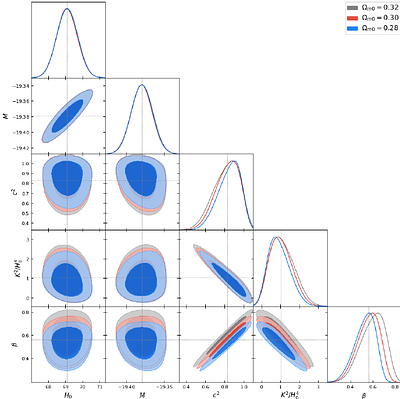
We study the cosmological and thermodynamic implications of holographic dark energy derived from the Kaniadakis deformation of the Bekenstein-Hawking entropy. Within a spatially flat FLRW background, the generalized entropy leads to an effective dark energy density containing an infrared correction proportional to $H^{-2}$, modifying the dynamics of the apparent horizon. Using the Hayward Kodama formalism, we obtain a geometric equation of st... more
We study the cosmological and thermodynamic implications of holographic dark energy derived from the Kaniadakis deformation of the Bekenstein-Hawking entropy. Within a spatially flat FLRW background, the generalized entropy leads to an effective dark energy density containing an infrared correction proportional to $H^{-2}$, modifying the dynamics of the apparent horizon. Using the Hayward Kodama formalism, we obtain a geometric equation of state and perform a criticality analysis, revealing a Van der Waals type structure with an inverted first order phase transition and a non physical swallowtail behavior in the Gibbs free energy, indicative of unstable thermodynamic branches. We further examine a dynamical extension including a $\dot{H}$ contribution and show that the unconventional critical behavior persists. The phenomenological viability of the model is tested through a joint statistical analysis with cosmic chronometers, PantheonPlus Type Ia supernovae, and DESI baryon acoustic oscillation data. These results establish Kaniadakis holographic cosmology as a consistent framework linking generalized entropy, gravitational thermodynamics, and observationally viable dark energy dynamics. less
By: Lang Cheng, Xiaobo Guo, Yuhan Li, Jun Tao, Peng Wang
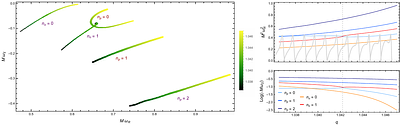
Exceptional points (EPs) in quasinormal mode (QNM) spectra are non-Hermitian degeneracies at which both the eigenvalues and eigenfunctions coalesce. In this paper, we identify an EP in the scalar QNM spectrum of hairy black holes in the Einstein-Maxwell-scalar theory by scanning the parameter space. We then investigate its implications for ringdown signals by extracting QNMs from time-domain waveforms. Our results show that an EP ansatz, whic... more
Exceptional points (EPs) in quasinormal mode (QNM) spectra are non-Hermitian degeneracies at which both the eigenvalues and eigenfunctions coalesce. In this paper, we identify an EP in the scalar QNM spectrum of hairy black holes in the Einstein-Maxwell-scalar theory by scanning the parameter space. We then investigate its implications for ringdown signals by extracting QNMs from time-domain waveforms. Our results show that an EP ansatz, which includes a resonant contribution containing a term linear in time, provides a more robust description of ringdown at the EP than the standard ansatz based on a superposition of independent damped modes. In particular, it captures the resonant contribution associated with spectral coalescence more naturally and enables a more reliable extraction from the ringdown signal. less
By: Thiago Campos
While the quasi-local thermodynamics of spherically symmetric black holes is well described by pressure and volume, extending this framework to rotating spacetimes poses a significant challenge. Rotation induces an oblate deformation of the horizon, breaking the direct functional dependence between geometric volume and area. In this work, we resolve this difficulty by establishing a quasi-local thermodynamic framework for Kerr-Newman black ho... more
While the quasi-local thermodynamics of spherically symmetric black holes is well described by pressure and volume, extending this framework to rotating spacetimes poses a significant challenge. Rotation induces an oblate deformation of the horizon, breaking the direct functional dependence between geometric volume and area. In this work, we resolve this difficulty by establishing a quasi-local thermodynamic framework for Kerr-Newman black holes. We demonstrate that accommodating this kinematic deformation requires extending the thermodynamic phase space to include a geometric eccentricity parameter $Y$ and its conjugate, a thermodynamic shear tension $X$. Consequently, the rotational contribution is incorporated into the first law with a shear work term $X dY$. We derive the generalized first laws and Smarr formulas (Euler relations) for both the internal energy and enthalpy representations, showing that these thermodynamic potentials can be obtained through Legendre transformations that isolate the quasi-local energy from the rotational energy. Thus, this framework provides a novel perspective on the thermodynamics of rotating black holes, integrating the geometric deformation of the horizon into a quasi-local description. less