Testing the strong equivalence principle with multimessenger binary neutron star mergers

Testing the strong equivalence principle with multimessenger binary neutron star mergers
Jie Zhu, Hanlin Song, Zhenwei Lyu, Hao Li, Peixiang Ji, Jun-Chen Wang, Haobo Yan, Bo-Qiang Ma
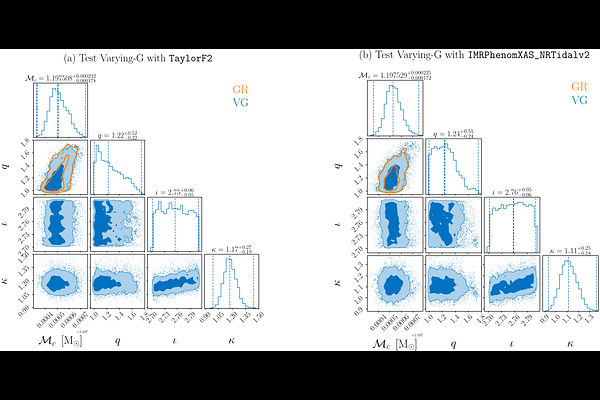
AbstractThe constancy of the gravitational constant $G$ is a cornerstone of the strong equivalence principle and of general relativity, yet its possible temporal variation remains a key target in tests of fundamental physics. Gravitational-wave (GW) astronomy, especially when combined with electromagnetic observations, provides an unprecedented new opportunity to probe this principle in the strong-field and dynamical regime. In this work, we develop a GW waveform model with a slowly varying gravitational constant, incorporating its effects both on compact binary dynamics and GW propagation in an expanding universe. Applying this framework to the binary neutron star merger GW170817, together with independent electromagnetic constraints on the luminosity distance, sky localization and binary inclination from GRB 170817A, we perform a joint Bayesian analysis that disentangles varying-$G$ effects from astrophysical degeneracies. We find no evidence for a temporal variation of the gravitational constant, and constrain its fractional time derivative to $\dot{G}/G \in [-3.36 \times 10^{-9}, 5.34\times10^{-10}]~{\rm yr^{-1}}$, representing the most stringent bounds obtained to date from real GW observations. Our results demonstrate the power of multi-messenger astronomy as a precision probe of the strong equivalence principle in the relativistic regime.