Antigenic landscape of a highly mutated SARS-CoV-2 Spike in ongoing viral evolution

Antigenic landscape of a highly mutated SARS-CoV-2 Spike in ongoing viral evolution
Turelli, P.; Eray, E.; Raclot, C.; Trono, D.; Antanasijevic, A.
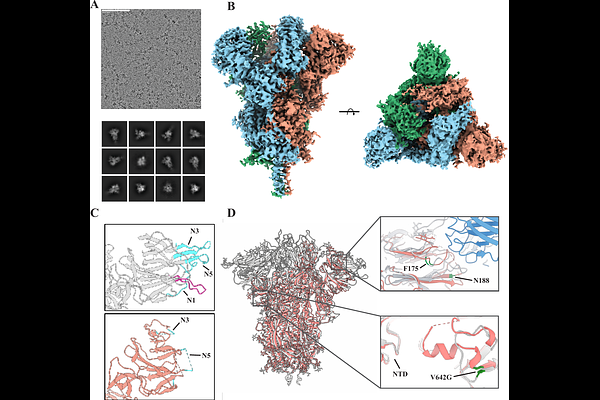
AbstractThe ongoing emergence of SARS-CoV-2 variants in an increasingly immune-experienced population is largely enabled by the plasticity of the Spike protein, which lies at the frontline of host immune pressure. Here, we investigated how extensive remodeling of the N-terminal domain (NTD) in Spike influences its antigenic properties. Using BA.2.87.1, a variant heavily mutated in this domain, we found that even large deletions do not substantially disrupt overall Spike structure or pseudovirus infectivity. However, our structural and binding analyses revealed that the NTD exhibits increased flexibility and that interaction with a heme-metabolite, contributing to assembly of an immunodominant epitope, is lost. These conformational effects, coupled with 33 NTD mutations, compromised the ability of human convalescent antibodies to engage this domain, contributing to their reduced neutralizing capacity. Consequently, BA.2.87.1-like variants may escape recognition by the pre-existing NTD-targeting antibodies, potentially reducing protection. Together, our results highlight the intrinsic adaptability of the Spike beyond the receptor-binding domain, with important implications for immune escape during viral evolution.