Development of Audiovisual Integration in Beginning Readers: A Longitudinal fMRI Study

Development of Audiovisual Integration in Beginning Readers: A Longitudinal fMRI Study
Braverman-Jaiven, D.; Farah, R.; Kraus, D.; Zehngut, O.; Michaeli, T.; Carmel, R.; Elor, A.; Shapira-Rootman, M.; Skeide, M. A.; Finnemann, J.; Horowitz-Kraus, T.
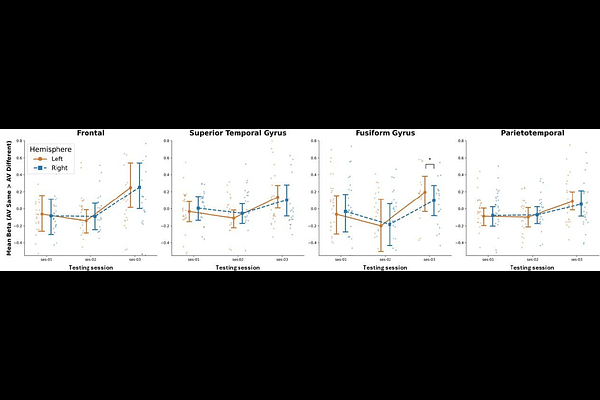
AbstractAcquiring reading proficiency, unlike spoken language, requires the brain to engage several specialized neural systems to map visual symbols (letters) to their corresponding phonological sounds (audiovisual integration), laying the foundation for fluent reading. This study investigates the neural and behavioral trajectory of developing audiovisual (AV) integration during the first year of learning to read. Thirty-two healthy Hebrew-speaking first-grade children were assessed at 3 time points across the school year: beginning, middle, and end of first grade. Participants underwent behavioral testing and brain fMRI scans while performing a block-design fMRI task involving AV matching or non-matching letters and sounds. Together with improvement in behavioral test scores related to general abilities, working memory, cognitive flexibility, and phonemic abilities, a Drift Diffusion Modeling (DDM) analysis of the accuracy and reaction time across sessions suggested faster and more efficient responses as the year progressed. fMRI results showed a significant increase in activation, from the beginning to the end of the first grade, in the left superior temporal gyrus (STG), frontal cortices and parietotemporal cortices, with a shift towards left-lateralization in the fusiform gyrus at the end of the year. These findings point towards the second half of the first grade as the time window for neural specialization and lateralization to phonological and orthographic information. A significant positive correlation between the fusiform gyrus activation and naming objects and colors scores across all sessions links this neural specialization to cognitive flexibility behavioral skills.