Zebra finch females flexibly communicate with each other and with AI-driven acoustic interaction models

Zebra finch females flexibly communicate with each other and with AI-driven acoustic interaction models
James, L. S.; Hoffman, B.; Liu, J.-Y.; Miron, M.; Alizadeh, M.; Fernandez, E.; Geist, M.; Kim, D.; Raskin, A.; Sakata, J. T.; Chemla, E.; Pietquin, O.; Woolley, S. C.
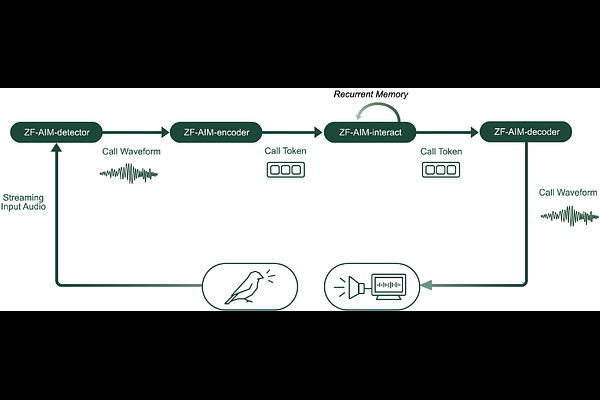
AbstractVocal interactions are widespread across animals and important for many social behaviors. For example, during human conversation, speakers are sensitive to response contingencies and modulations of acoustic structure from their partner, and produce real-time modulations of their own sounds based on the interaction. However, the behavioral principles underlying these exchanges across species remain poorly understood; simultaneously, emerging AI technologies offer promising avenues for studying communication dynamics. Here we analyzed over 1.5 million female zebra finch calls produced during vocal interactions and found that finches exhibited correlated call production, rapid structural modulation, response selectivity, and vocal covariation during dyadic exchanges. Aspects of vocal interactions were reduced when birds engaged with non-interactive playbacks. Therefore, we developed a generative audio-LLM that engaged in real-time vocal interactions with zebra finches (ZF-AIM: Acoustic Interaction Model). Interactions in silico between two copies of ZF-AIM reproduced the contingencies and vocal covariation observed under natural conditions. Moreover, when birds interacted with ZF-AIM, their vocal production and flexibility recapitulated key naturalistic features. Removing ZF-AIM's acoustic flexibility (while maintaining response interactivity) impaired aspects of natural interactions. Our study uncovered surprising adaptability of innate vocalizations and provides a powerful and generalizable framework for understanding animal communication.