Gain-of-function mutation in SKAP2 leads to type 1 diabetes and broader autoimmunity through hyperactive integrin signaling in myeloid cells

Gain-of-function mutation in SKAP2 leads to type 1 diabetes and broader autoimmunity through hyperactive integrin signaling in myeloid cells
Tamaki, C. M.; Chamberlain, C. E.; Abram, C. L.; Poojary, S.; Bridge, J.; Matsuda, J. L.; Tamaki, W.; Rutsch, N.; Spector, L.; Dixon, W.; Proekt, I.; Letourneau-Freiberg, L. R.; Philipson, L. H.; German, M. S.; Anderson, M. S.; Lowell, C. A.
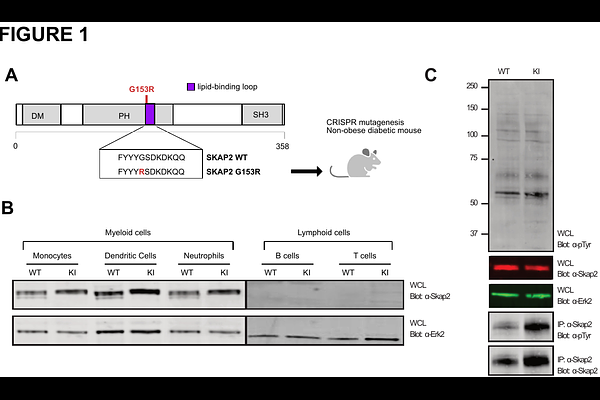
AbstractMany genetic variants associated with increased type 1 diabetes (T1D) risk are located within the SKAP2 gene; however, the mechanisms by which these variants confer disease risk remain unclear. SKAP2 encodes an adapter protein that functions within the integrin signaling pathway and is found at the highest levels in myeloid leukocytes. We recently identified a de novo gain-of-function SKAP2 mutation in an individual with T1D, leading to hyperactive integrin signaling in myeloid cells. To dissect the mechanisms by which this mutation may lead to T1D, we generated a knock-in mouse line containing the orthologous p.G153R substitution in mouse SKAP2 on the diabetes-prone nonobese diabetic (NOD) genetic background. Both female and male SKAP2 G153R/G153R mice developed accelerated T1D. The SKAP2 G153R/G153R mice also exhibited a unique spectrum of autoantibodies, leading to immune-complex nephritis. Accelerated infiltration of pancreatic islets by myeloid cells, B lymphocytes, and activated T cells was observed in SKAP2 G153R/G153R mice. Single-cell RNA sequencing demonstrated a type 1 IFN{gamma}-driven inflammatory program within the pancreatic islets of SKAP2 G153R/G153R mice. Dendritic cells from SKAP2 G153R/G153R mice demonstrated increased antigen-presenting capacity, characterized by enhanced adhesion to T cells during immune synapse formation. Macrophages and neutrophils from SKAP2 G153R/G153R mice also showed increased integrin signaling responses, with neutrophils expressing high levels of activated {beta}2 integrins on the cell surface. When backcrossed onto the C57BL/6J genetic background, the SKAP2 G153R/G153R mice developed spontaneous autoantibody formation and exhibited accelerated autoimmunity, including nephritis, in the pristane-induced model of autoimmune disease. These findings demonstrate that dysregulation of leukocyte integrin signaling, through alterations in SKAP2, may increase the genetic risk for autoimmunity and T1D.