Integrated analysis of stemness-associated immune modulatory circuits in squamous cell carcinomas

Integrated analysis of stemness-associated immune modulatory circuits in squamous cell carcinomas
Guo, W.; Leon, D.; Luan, J.; Gang, A.; Huang, X.; Nicholson, B.; Dorosz, K.; Zhao, Y. S.; Grimshaw, S.; Bolotin, D.; Lingen, M. W.; Vokes, E. E.; Pearson, A.; Rosenberg, A. J.; Shen, L.; Izumchenko, E.; Agrawal, N.; Jiang, J.; Miao, Y. P.
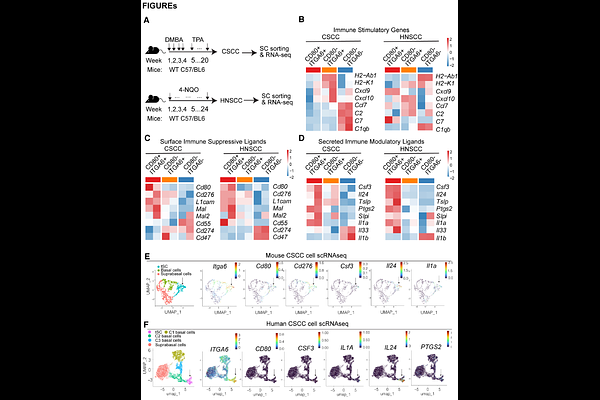
AbstractEmerging evidence indicates that a subset of cancer cells enriched for stemness-related gene signatures possess distinct immunomodulatory capacities, enabling these tumor-initiating stem cells (tSCs) to more effectively evade or resist anti-tumor immunity. Despite these advances, the tSC-specific molecular circuits orchestrating their specialized immune privilege program are not well defined. Here, in squamous cell carcinomas of the skin and oral cavity, we comprehensively delineate the unique immune-evasive properties of tSCs and dissect the transcriptional regulation shaping their immunomodulatory programs. By integrating transcriptome profiling, chromatin landscape mapping, genetic perturbation, and single-cell RNA sequencing, we found that the tSC-specific immune program is broadly governed by SOX2, a stemness-associated transcription factor. We demonstrate that SOX2 enables tSCs to sustain immature tumor-associated neutrophils (TANs) and subsequently trigger these myeloid cells to foster the development of tumor-associated macrophages (TAMs). This SOX2-directed tSC-TAN-TAM axis establishes a localized immunosuppressive niche for protecting tSC. Here, we uncover SOX2 as a master regulator that orchestrates conserved immune modulatory circuits in tSCs to sustain pro-tumor myeloid cell states. These findings place tSCs at the apex of immune landscape remodeling, asserting a central role of stemness-associated program in organizing the immunosuppressive tumor microenvironment.