How Resource Heterogeneity and Social Threat Shape Intergroup Tolerance: Insights from a Spatial Agent-Based Model

How Resource Heterogeneity and Social Threat Shape Intergroup Tolerance: Insights from a Spatial Agent-Based Model
Grueter, C. C.
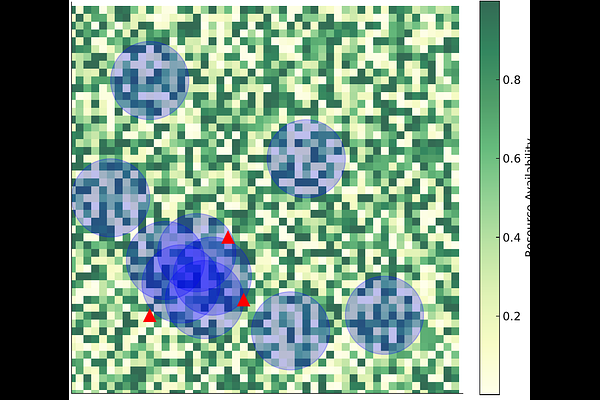
AbstractThe emergence of tolerance between distinct social groups is a central question in social evolution, with relevance to both nonhuman primates and early human societies. Ecological factors such as resource heterogeneity and social threats like bachelor male presence have each been proposed as drivers of intergroup proximity, but their combined effects remain unclear. We developed a spatially explicit agent-based model to examine how resource patchiness and bachelor threat jointly shape aggregation dynamics and intergroup tolerance among mixed-sex groups. In the model, groups forage across heterogeneous landscapes and expand their ranges with increasing patchiness. Bachelor males roam independently and pose localized threats, prompting groups to aggregate probabilistically according to threat intensity. Aggregation decisions follow a sigmoid response, and familiarity accumulates through repeated overlap or joint aggregation. Intergroup tolerance thus arises from encounter histories rather than being preprogrammed. Simulations show that resource heterogeneity promotes tolerance by increasing overlap and encounter frequency, while bachelor threat induces aggregation as a protective response. Tolerance can also emerge without consistent aggregation, provided that ecological conditions repeatedly bring groups together. When both heterogeneity and threat are high, aggregation and familiarity peak, indicating a synergistic effect. These outcomes are robust across a wide parameter space and do not require explicit coordination or cooperative intent. Our findings highlight how simple behavioral rules embedded in ecological and social contexts can yield complex intergroup outcomes, offering a general framework for understanding the evolution of intergroup tolerance in primates and humans.