Between specialization and flexibility: how tasks and space shape behavioral profiles in ant colonies

Between specialization and flexibility: how tasks and space shape behavioral profiles in ant colonies
Fernandez-Lopez, P.; Jolles, J. W.; Oro, D.; Bartumeus, F.
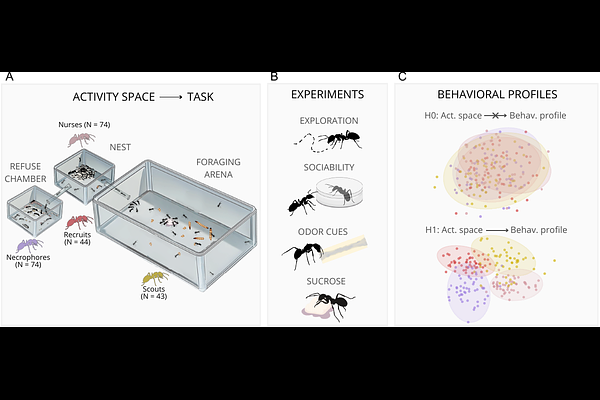
AbstractTask allocation in eusocial insects has long been studied under the framework of division of labor, implying a relatively rigid association between individuals and tasks. However, most eusocial species lack morphological specialization, and workers regularly switch tasks as colony demands change. This raises a fundamental question: do tasks shape the behavioral profiles of workers, or does individual behavioral variation cut across task boundaries? We addressed this in a controlled laboratory study of \textit{Aphaenogaster senilis} ants, comparing the behavioral profiles of four task groups (scouts, recruits, nurses, and necrophores) spatially segregated by their location within the colony setup and subsequently tested individually in four ecologically relevant contexts. This multivariate profiling, still rarely applied in ants, revealed large within-task variability and broad overlap across groups in communication-based traits, while foraging-related traits, particularly sucrose responsiveness, reliably distinguished nurses from scouts. UMAP clustering showed scouts and nurses occupying opposing regions of the behavioral space, with necrophores and particularly recruits displaying intermediate and broader profiles. Thus, our findings reveal a task-related behavioral landscape intermediate between strict specialization and complete flexibility. More broadly, they suggest that task-associated behavioral structure can emerge from the spatial organization of the colony itself, with profiles spanning a continuum from narrow and specialized to broad and flexible according to each group's spatial range: most notably, its position inside or outside the nest. This offers a parsimonious mechanism by which decentralized systems balance specialization against the flexibility needed to respond to environmental change.