Effects of artificial light colour, intensity, structure and contrast on moth flight behaviour

Effects of artificial light colour, intensity, structure and contrast on moth flight behaviour
Briolat, E. S.; Galloway, J. A. M.; van Berkel, M.; Bennie, J.; Gaston, K. J.; Troscianko, J.
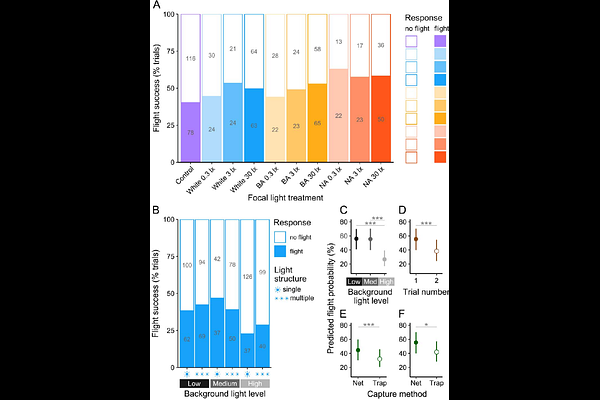
AbstractNocturnal moths are severely affected by light pollution, most notoriously through fatal attraction to artificial lights, yet flight-to-light is not their only response. To investigate how artificial lights impact flight behaviour, we exposed over 1200 wild-caught moths of 62 species to LED lights with different characteristics, under varying background lighting conditions, and tracked over 500 flight paths in three dimensions. Flight-to-light behaviour and flight tortuosity both increased with light intensity, irrespective of spectrum, though tortuosity was affected by lower levels of white than amber light, suggesting white LEDs could impact moth trajectories from greater distances. Flight tortuosity was also higher upon exposure to a single light versus three producing equivalent illuminance. Conversely, higher background light levels led to reductions in both flight-to-light and tortuosity, but moths were also less likely to take flight in these conditions, suggesting that both point sources and diffuse background lighting disrupt moth movement. Finally, moths caught using light traps were less likely to fly and, if they did, more likely to fly towards light sources than those caught with butterfly nets. These findings suggest mitigation policies for light pollution should prioritize reducing light intensity, and point to new directions for future research.