Fleeing is Believing: Adaptive behavior under social threat as an inference process

Fleeing is Believing: Adaptive behavior under social threat as an inference process
Khurana, H. S.; Mussetto, V.; Gross, C. T.; Bufacchi, R. J.
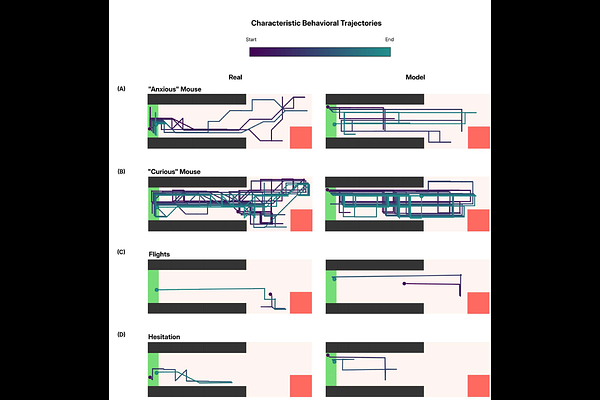
AbstractAdverse social experiences profoundly alter animal behavior, yet the processes underlying context-appropriate behavior selection based on prior social interactions remain poorly understood. Existing models capture statistical patterns but are not framed in mechanistic frameworks that explain individual variability and predict behavioral outcomes. We address this gap by modeling social defeat in mice as a partially observable Markov decision process (POMDP), implementing a heterarchical agent architecture - a structured network of interacting modules balancing exploration and exploitation. Our model successfully reconstructs observed behavioral motifs (e.g., investigation, hesitation, and flights), fits different mouse phenotypes (e.g., susceptible vs. resilient), and mechanistically captures the impact of social defeat as a parameter shift in the animal's internal generative model. The model reproduces effects of interventions like optogenetic stimulation, and generates testable predictions for future experiments. The model's modular architecture enables natural extension to other behavioral domains including foraging and multi-agent interactions, representing a foundational step toward interpretable models of mouse behavior. By capturing how adverse social experiences reshape decision-making at the computational level, this work offers potential clinical relevance for trauma and anxiety disorders in humans.