Fibroblast-Enhanced Tumour Microenvironment Signalling Promotes Adaptive Doxorubicin Tolerance in Heterotypic Melanoma Spheroids

Fibroblast-Enhanced Tumour Microenvironment Signalling Promotes Adaptive Doxorubicin Tolerance in Heterotypic Melanoma Spheroids
Pavel, I. O.; Negrea, G.-G.; Meszaros, S.; Rauca, V.-F.; Dume, B.-R.; Licarete, E.; Patras, L.; Dragan, S.; Toma, V. A.; Sesarman, A.; Banciu, M.
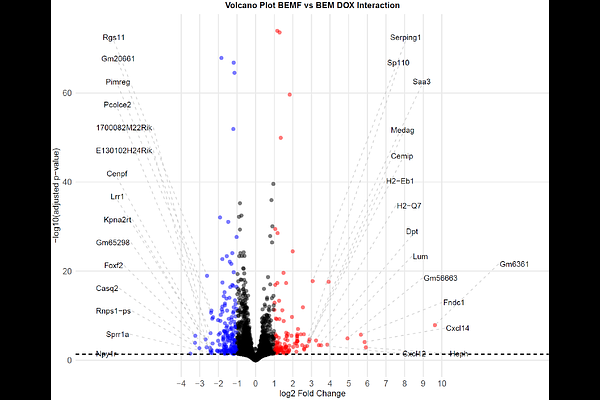
AbstractMelanoma is an aggressive malignancy that rapidly adapts to therapy. While chemotherapy resistance has traditionally been attributed to tumour-intrinsic mechanisms, growing evidence implicates the tumour microenvironment in shaping drug tolerance. However, few in vitro models capture the stromal complexity needed to study this interaction. We developed two multicellular melanoma spheroid models of increasing stromal complexity: a baseline model of melanoma, endothelial, and macrophage cells (BEM), and a fibroblast-containing counterpart (BEMF), and compared their transcriptional response to doxorubicin. Fibroblast inclusion increased the doxorubicin concentration required to achieve comparable growth inhibition. While untreated BEMF spheroids exhibited only modest baseline transcriptional differences, they showed a profoundly reshaped transcriptional response after doxorubicin exposure, displaying broader and higher-magnitude changes. These responses were characterized by suppression of proliferative and cell-cycle programmes, together with activation of inflammatory, immune-associated, metabolic, and stress-adaptive pathways. Higher-resolution pathway analyses further revealed coordinated attenuation of mitotic progression, checkpoint regulation, homologous recombination repair, and Rho GTPase signalling, consistent with a shift toward stress-adaptive and phenotypically plastic states, rather than classical resistance mechanisms. Transcriptome-derived transcription factor activity inference supported this regulatory rewiring. Integration with curated resistance-associated genes and external transcriptomic datasets demonstrated strong conservation of core transcriptional features across heterogeneous experimental systems, including consistent suppression of proliferation-associated genes and induction of inflammatory signalling programmes. Together, these findings indicate that fibroblasts redirect chemotherapy responses toward a stress-adaptive, persister-like phenotype and establish fibroblast-containing 3D melanoma spheroids as a physiologically relevant platform for studying tumour microenvironment-mediated chemotherapy tolerance and stromal-tumour interactions.