Lymphocyte damage in four differently treated prostate radiotherapy cohort

Lymphocyte damage in four differently treated prostate radiotherapy cohort
Kocsis, Z. S.; Agoston, P.; Farkas, G.; Szekely, G.; Sandor, G. O.; Kliton, J.; Gesztesi, L.; Major, T.; Pesznyak, C.; Herein, A.; Stelczer, G.; Mihaly, D.; Frohlich, G.; Takacsi-Nagy, Z.; Polgar, C.; Juranyi, Z.
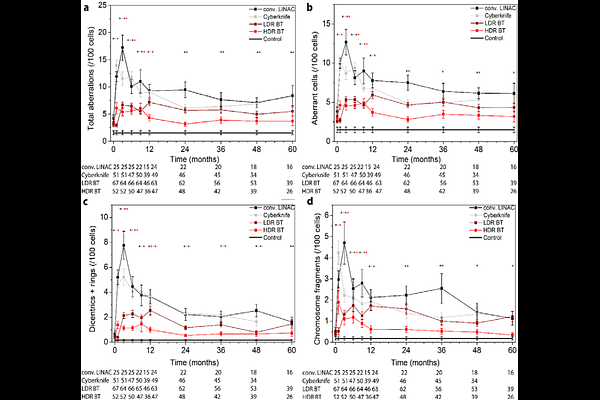
AbstractBackground: As the assessment of lymphocyte damage caused by radiotherapy gains importance as immunotherapies are used more frequently. Furthermore, there is scarce data to compare the biological dose of radiotherapy techniques in the same patient group. Methods: Applying chromosome aberration technique, a five-year long (at 3, 6, 9, 12, 24, 36, 48, 60 months) prospective comparison of the biological impact of four different types of treatments for low- and intermediate risk prostate cancer was performed (195 patients): conventional LINAC (linear accelerator) (between 70 and 78 Gy) and Cyberknife (between 40 and 37.5 Gy) teletherapy, LDR (low dose rate brachytherapy, 145 Gy) and HDR (high dose rate brachytherapy 19 or 21 Gy). Multivariate regression analyses were performed to analyze the predictive potential of the chromosome aberrations on side effects. The median follow-up was between 48 and 60 months. Results: We have found that teletherapy techniques (conv. LINAC and Cyberknife therapy) caused between 1.7 and 3.2-fold more chromosomal aberrations than brachytherapies. At three months, between 4.6% and 12.7% of the lymphocytes were damaged. Five years after treatment, the total aberration values of conventional LINAC and LDR brachytherapy patients were still significantly higher than before the therapy (p=0.035 for LINAC and p=0.003 for LDR BT). We found significant regression models suggesting chromosome aberration might predict side effects beside radiation dose and irradiated volumes (V100%): Late genitourinary (GU) side effects were dependent of chromosome fragments directly after conv. LINAC therapy (p=0.005). Conclusions: We demonstrated long-term lymphocyte damage dependent on the type of radiotherapy. We also found less biological dose and side effects in brachytherapy patients.