Machine Learning-Enhanced Nanopore ITS Analysis: Evaluating CPU-GPU Pipelines for High-Accuracy Fungal Taxonomic Resolution

Machine Learning-Enhanced Nanopore ITS Analysis: Evaluating CPU-GPU Pipelines for High-Accuracy Fungal Taxonomic Resolution
Albuja, D. S.; Maldonado, P. S.; Zambrano, P. E.; Olmos, J. R.; Vera, E. R.
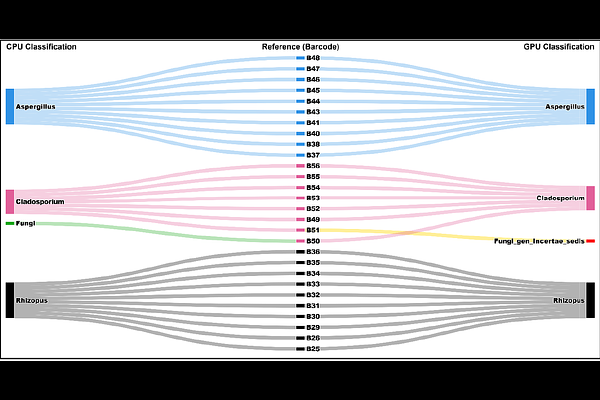
AbstractAccurate fungal species identification is critical for microbial ecology, food safety, and plant pathology. However, morphological limitations and genomic complexity hinder this process. Molecular markers such as the ITS region, along with Oxford Nanopore long-read sequencing, offer a robust solution, albeit limited by error rates in homopolymeric regions and a high dependence on advanced computational resources (GPUs) to achieve high accuracy. This study benchmarks two bioinformatics workflows on a multiplexed dataset of complex fungal communities to address this technological gap: a CPU-based workflow optimized using a Bayesian machine learning engine and a GPU-accelerated workflow incorporating "super high accuracy" (SUP) models and refinement with neural networks. The results establish a scalable framework for evaluating the impact of computational architecture on final taxonomic resolution. It is demonstrated that GPU processing maximizes data retention and species-level accuracy by correcting systematic errors. Alternately, implementing automated hyperparameter optimization in CPU environments stabilizes sequence clustering and achieves high taxonomic concordance at the genus level. This conceptual advance validates the feasibility of performing ITS metabarcoding analysis in resource-constrained infrastructures, thus providing the scientific community with a reproducible protocol that balances the need for taxonomic precision with hardware availability.