Enhancement of a STING Agonist Vaccine for Tuberculosis Using Locally Supercharged MS2 Viral Capsids

Enhancement of a STING Agonist Vaccine for Tuberculosis Using Locally Supercharged MS2 Viral Capsids
Martin, H. S.; amb-Echegaray, I. D.; Huang, P.; Shallow, L.; Balakhmet, A.; Pratakshya, P.; Stanley, S.; Francis, M. B.
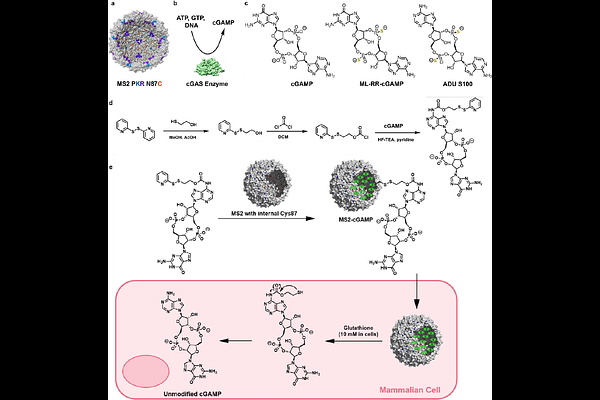
AbstractMycobacterium tuberculosis (Mtb) infection kills more people worldwide than any other pathogen. While the Bacille Calmette-Guerin (BCG) vaccine for Mtb has been widely used for over a century, it provides insufficient protection to eradicate this disease. One of our labs has recently established that a protein antigen (H1) can be combined with a STING pathway agonist to achieve strong protection against Mtb in mice, with performance that exceeds that of the BCG vaccine. However, its reliance on a synthetic cyclic dinucleotide (CDN) with relatively poor cell uptake requires higher dosing levels, thus increasing costs. To increase the efficiency of this vaccine and provide a delivery strategy that could also be used in humans, the H1 Mtb antigen and CDN adjuvant were conjugated to genome-free MS2 viral capsids that included cationic mutations to increase cell uptake. Specifically, the H1 antigen was conjugated to the external surface of MS2 using a tyrosinase-mediated oxidative coupling reaction, and the native STING agonist cGAMP was coupled to internal cysteine residues through a reductively cleavable disulfide linker. The resulting MS2-H1 and MS2-cGAMP conjugates were then co-delivered for three doses of vaccination in mice before exposure to Mtb. The MS2-based vaccine platform was observed to have comparable efficacy to the original H1/CDN formulation, but its enhanced uptake properties enabled 57-fold less CDN and 3-fold less H1 antigen. Additionally, this vaccine elicited immune responses that have been previously demonstrated to correlate with protection. The ability of the capsid shells to protect the CDN cargo during transport allowed enzymatically produced, and thus readily accessible, cGAMP to be used instead of more costly CDNs that require many synthetic steps. This, combined with the reduced overall amount of CDN and H1 that was required, could lower the production costs of future vaccines substantially. Finally, the ability of the capsid-based carriers to bypass the membrane transporters for CDNs suggests that this enhanced vaccination platform is likely to exhibit improved human efficacy in future studies.