Tumor reactivity assessment using clonal expression (TRACE) reveals tumor reactive CD8+ T cell heterogeneity across solid tumors

Tumor reactivity assessment using clonal expression (TRACE) reveals tumor reactive CD8+ T cell heterogeneity across solid tumors
Monteiro, D.; Denebeim, J.; Dodson, A. E.; Yeri, A.; Ghose, M.; Travers, M.; Capobianco, S.; Calnan, C.; Martinez, G. J.; Yoon, C. H.; Wong, K.; Benson, M. J.; Sangurdekar, D.
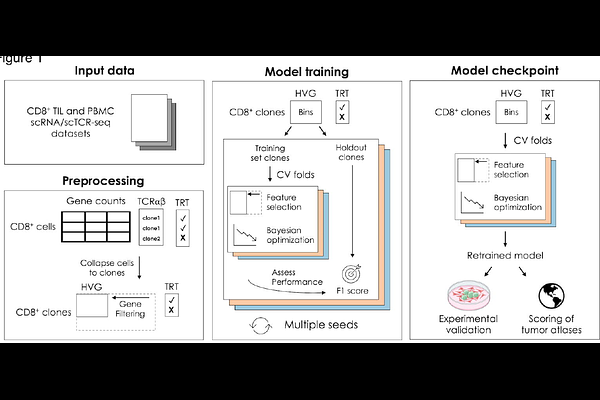
AbstractIntroduction: Tumor infiltrating lymphocytes (TIL) drive the anti-tumor activity of a broad class of immunotherapies. In situ TIL are composed of T cells that recognize tumor antigens (Tumor Reactive T cells, or TRTs) as well as bystander T cells with specificity for other antigens. TRT clonotypes are associated with a unique and tumor-driven exhausted transcriptional state, enabling single-cell RNA sequencing (scRNA-seq)-based predictive models for TRTs using experimentally validated clone labels. Methods: In this study, a clonotype-level CD8+ TRT classifier (TRACE) was built using an aggregated dataset of validated tumor reactive clonotypes and associated scRNA-seq data from multiple publications that overcomes the limitations of training on a single dataset, donor, or indication. TRACE does not require dataset manipulation for training or prediction, enabling it to be easily applied to new test datasets as they emerge. Results: TRACE exhibited robust performance on held-out TIL and PBMC clones - achieving a mean Matthews correlation coefficient of 0.84 and F1-score of 0.85 - comparable to or outperforming other TRT prediction methods. We experimentally confirmed the reactivity of TRACE-identified TRT clones by co-culturing engineered, ex vivo expanded TIL with autologous melanoma tumor cell lines. Finally, we applied TRACE to evaluate the frequency of TRT across hundreds of patient samples from multiple tumor atlases spanning lung, colorectal, and pancreatic cancer. TRACE scores were observed to be significantly higher in exhausted CD8 T cells in tumors but not in exhausted cells in normal adjacent or non-cancer samples, suggesting specificity towards identifying tumor-antigen experienced T cells. Conclusion: TRACE is a tumor reactivity scoring algorithm released with open model weights that can be applied to tissue or blood single-cell RNAseq datasets. Its application should be of general interest for characterizing the fraction of TRTs in TIL and for establishing correlations with clinical response to immunotherapies.