DNA Protonuclei as Programmable Nuclear Mimics Reveal Environmental Context on Protein Phase Separation

DNA Protonuclei as Programmable Nuclear Mimics Reveal Environmental Context on Protein Phase Separation
Dormann, D.; Walther, A.; Fritzen, J.; Samanta, A.; Kuhr, N. S.; Sternburg, E.
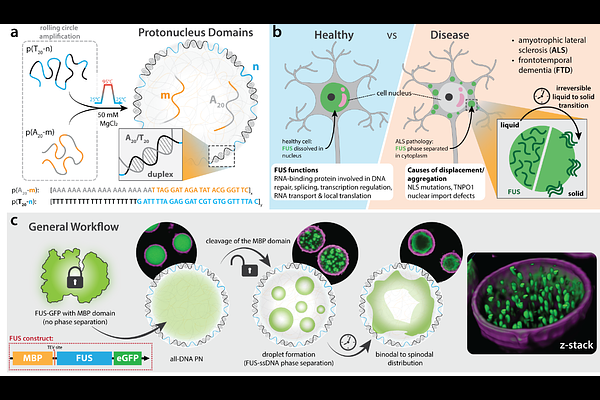
AbstractUnderstanding protein phase separation in cellular environments remains a major challenge, as ex vivo assays often fail to capture the influence of environmental context, such as crowding, multimodal interactions, and the dynamic properties of the cytosol or nucleus. Here, we introduce programmable DNA-based protonuclei (PN) as nucleus-mimicking compartments to probe phase separation of the neurodegeneration-linked protein FUS. We show that FUS partitioning and condensate formation are highly sensitive to nucleic acid sequence, spatial confinement, and viscoelastic properties of the PN core. Notably, classical test-tube affinity assays fail to predict protein behavior within the crowded and multivalent PN environment. By tuning DNA crosslinking, we modulate condensate dynamics and suppress liquid-to-solid transitions of FUS, a hallmark of disease. These findings demonstrate that multivalent, confined environments fundamentally reshape protein-nucleic acid interactions and phase behavior. The PN platform complements test-tube assays and complex cellular settings and enables to dissect nuclear condensates under controllable conditions.