Intentional control of instrumental punishment

Intentional control of instrumental punishment
Varas, F. I.; Dickinson, A.; Perez, O. D.
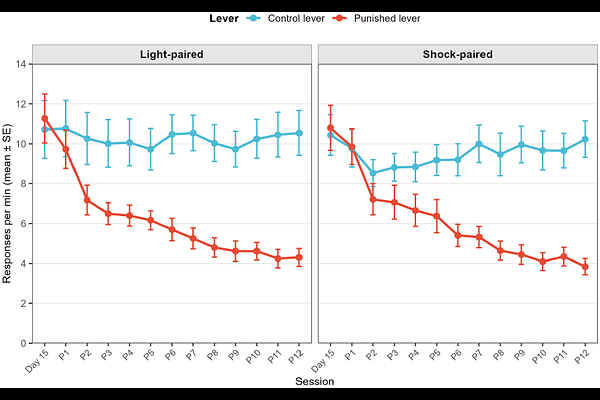
AbstractTheories of learning have attributed the decrease in responding observed after instrumental punishment to a reflexive Pavlovian suppression mechanism or habit-like response inhibition. Here, we show that punished performance is driven by a causal instrumental representation that encodes the current value of the punisher. Rats were trained on a concurrent instrumental reward procedure for a common outcome. After training, footshock punishment was delivered for presses on one lever while the reward contingency was still in effect; the second lever was matched for reinforcement but remained unpunished. We then revalued the shock using a separate counterconditioning protocol under which for one group it was paired with the reward used for instrumental learning and unpaired with the reward for another group. In a subsequent extinction test, revaluation of shock selectively restored responding on the previously punished lever to the level of the unpunished control. By contrast, the group for which the shock remained aversive responded less on the punished lever than on the unpunished one. Our results demonstrate that punishment is intentional: animals maintain a flexible representation of the punisher's value and integrate it with instrumental knowledge to regulate behavior. In this sense, punishment is motivationally and representationally structured in the same manner as canonical goal-directed reward seeking.