Inhibitory Control, Shifting, and Working Memory Updating Domains form Cognitive Phenotypes in Non-human Primates

Inhibitory Control, Shifting, and Working Memory Updating Domains form Cognitive Phenotypes in Non-human Primates
Wen, X.; Malchin, L.; Neumann, A.; Womelsdorf, T.
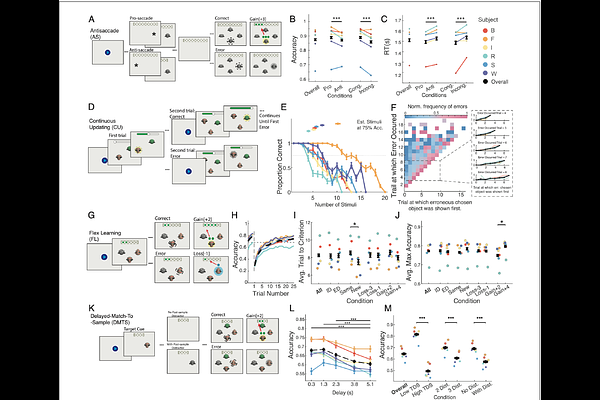
AbstractExecutive functions comprise at least four major subdomains: Inhibitory Control, Updating, Shifting, and Working Memory. Cognitive abilities in these subdomains are partially separable and partially unified in a common cognitive control factor in humans, but how these functions are organized in the nonhuman primate (NHP) is largely unknown. Here, we used a multi-task assessment approach and found that NHPs show within single sessions reliable cognitive markers of Inhibitory Control in an antisaccade task, (ii) Updating abilities in a multidimensional continuous updating task, (iii) Working Memory in a delayed matching task, and (iv) Shifting abilities in a feature-based rule learning task. First, we found that subjects' performance fell into three separable cognitive phenotypes with unique strengths and weaknesses across cognitive subdomains. Second, the most reliable cognitive metrics gave rise to four latent cognitive factors that quantify the relative independence of shifting/learning and working memory updating as well as independent variance explaining the abilities in inhibitory control of exogeneous versus endogenous interference. These findings support a 4-factor cognitive organization of executive functions in NHPs, with inter-subject differences of these factors forming cognitive phenotypes.