By: Zongyuan Qin, Taiyang Zhang, Qian Feng, Zheng-Wen Long
This paper investigates the characteristics of quasinormal modes (QNMs) of static, spherically symmetric black holes under the combined influence of spontaneous Lorentz symmetry breaking (LSB) induced by the Kalb-Ramond (KR) field and perfect fluid dark matter (PFDM). Using M87$^\ast$ shadow data from the Event Horizon Telescope (EHT), we constrain the LSB factor $τ$ and PFDM parameter $ζ$ at 1$σ$ confidence. By combining the sixth-order WKB ... more
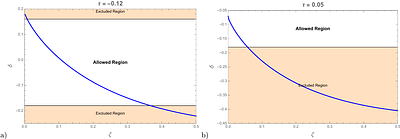
This paper investigates the characteristics of quasinormal modes (QNMs) of static, spherically symmetric black holes under the combined influence of spontaneous Lorentz symmetry breaking (LSB) induced by the Kalb-Ramond (KR) field and perfect fluid dark matter (PFDM). Using M87$^\ast$ shadow data from the Event Horizon Telescope (EHT), we constrain the LSB factor $τ$ and PFDM parameter $ζ$ at 1$σ$ confidence. By combining the sixth-order WKB approximation method with timedomain numerical integration, we systematically compute the complex frequency spectrum of QNMs for black holes in this spacetime background. The numerical results reveal an intriguing conclusion: as the LSB factor $τ$ or the PFDM parameter $ζ$ increases, both the real part and the absolute value of the imaginary part of the QNMs frequencies exhibit a monotonic increase, demonstrating a unique "stiffening" effect. This characteristic stands in stark contrast to the decreasing trend of QNMs frequencies observed in models that consider only traditional dark matter, revealing the critical influence of the coupling between the KR field and PFDM on the dynamic evolution of black holes. This study not only enriches and deepens the understanding of black hole perturbation theory within the framework of modified gravity but also, by identifying the distinctive spectral features of QNMs, offers the potential to distinguish whether the KR field and dark matter are coupled in future observations. Thus, it provides a theoretical foundation for testing mechanisms of spacetime symmetry breaking beyond the standard model and for exploring the nature of dark matter. less
10 SciCasts by .