By: Vittorio Barlucchi, Alex Gnech, Scilla Degl'Innocenti, Laura Elisa Marcucci
The astrophysical $S$-factor for the proton-proton fusion is calculated in the low-energy regime for a variety of nuclear interactions and consistent nuclear currents, derived within chiral effective field theory. We estimate, for the first time, the theoretical uncertainty on the $S$-factor due to the truncation of the chiral expansion of the currents using a Bayesian analysis. In order to reach an accuracy at the percent level in the calcul... more
The astrophysical $S$-factor for the proton-proton fusion is calculated in the low-energy regime for a variety of nuclear interactions and consistent nuclear currents, derived within chiral effective field theory. We estimate, for the first time, the theoretical uncertainty on the $S$-factor due to the truncation of the chiral expansion of the currents using a Bayesian analysis. In order to reach an accuracy at the percent level in the calculation, the electromagnetic potential includes contributions beyond the leading Coulomb interaction, such as two-photon exchange and vacuum polarization. The initial proton-proton state is expanded in partial waves and only the ${}^1S_0$ contribution is included, as it is known that the other partial-waves effects are negligible. The low-energy constant entering the contact term in the weak axial current operator is calibrated to reproduce the Gamow-Teller matrix element in Tritium $β$-decay. The value $S(0)$ is found to be $S(0)=(4.068 \pm 0.025)\times 10^{-25} \: \text{MeV}\: \text{b}$. less
By: Andrea Sabatucci, Armen Sedrakian
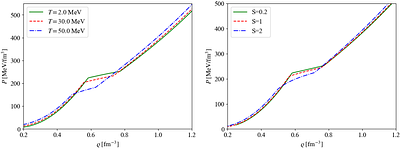
Binary neutron star mergers and proto-neutron stars provide unique environments where dense matter is hot, lepton rich, and potentially undergoes a transition from hadronic to deconfined quark matter. We investigate the thermodynamics and stellar properties of hybrid matter under such conditions. The hadronic phase is described within a covariant density functional framework, while the quark phase is modeled using a Nambu-Jona-Lasinio (NJL) m... more
Binary neutron star mergers and proto-neutron stars provide unique environments where dense matter is hot, lepton rich, and potentially undergoes a transition from hadronic to deconfined quark matter. We investigate the thermodynamics and stellar properties of hybrid matter under such conditions. The hadronic phase is described within a covariant density functional framework, while the quark phase is modeled using a Nambu-Jona-Lasinio (NJL) model that includes repulsive vector interactions, the axial $U_A(1)$-breaking 't Hooft determinant interaction, and two-flavor color-superconducting (2SC) pairing. The phase transition between hadronic and quark matter is constructed using a mixed-phase prescription that enforces baryon and lepton number conservation, allowing us to follow thermodynamic trajectories at fixed entropy per baryon and fixed lepton fraction. We analyze the phase structure of dense matter at finite temperature and study the composition of the hadronic, mixed, and quark phases in both neutrino-trapped and neutrino-free regimes. Our results show that neutrino trapping significantly modifies the particle composition and shifts the onset of deconfinement to higher densities. Using the resulting equations of state, we compute static stellar configurations and examine the influence of temperature and lepton content on the mass-radius relation of hybrid stars. Hot, neutrino-rich configurations are found to have larger radii and slightly higher maximum masses than their cold counterparts. less

By: Pietro Klausner, Marco Antonelli, Francesca Gulminelli
We perform a Bayesian analysis of the neutron star (NS) equation of state (EoS) based on a wide set of Skyrme functionals, derived from previous nuclear physics inferences. The novelty of this approach lies in starting from the full multidimensional posterior distribution of nuclear matter parameters, consistent with a comprehensive set of static and dynamic nuclear structure observables. We construct unified EoSs for $npe\mu$ matter, where t... more
We perform a Bayesian analysis of the neutron star (NS) equation of state (EoS) based on a wide set of Skyrme functionals, derived from previous nuclear physics inferences. The novelty of this approach lies in starting from the full multidimensional posterior distribution of nuclear matter parameters, consistent with a comprehensive set of static and dynamic nuclear structure observables. We construct unified EoSs for $npe\mu$ matter, where the inner crust of the NS is treated using an extended Thomas-Fermi method, providing for the first time a fully consistent Bayesian treatment of the correlation of bulk with surface as well as with spin-orbit and effective mass parameters. We then employ a standard Bayesian framework to identify those EoSs that satisfy astrophysical constraints from NS mass measurements, the tidal deformability from GW170817, and NICER mass-radius observations. We also examine NS observables, such as the crustal moment of inertia, which is crucial in understanding pulsar glitches. Compared to previous works, we observe an increase in both the NS surface thickness and the crustal moment of inertia. less

An Overview of the MUSES Calculation Engine and How It Can Be Used to Describe Neutron Stars
0upvotes
By: Mateus Pelicer, Veronica Dexheimer, Joaquin Grefa
For densities beyond nuclear saturation, there is still a large uncertainty in the equations of state (EoS) of dense matter that translate into uncertainties in the internal structure of neutron stars. The MUSES Calculation Engine provides a free and open-source composable workflow management system, which allows users to calculate the EoS of dense and hot matter that can be used, e.g. to describe neutron stars. For this work, we make use of ... more
For densities beyond nuclear saturation, there is still a large uncertainty in the equations of state (EoS) of dense matter that translate into uncertainties in the internal structure of neutron stars. The MUSES Calculation Engine provides a free and open-source composable workflow management system, which allows users to calculate the EoS of dense and hot matter that can be used, e.g. to describe neutron stars. For this work, we make use of two MUSES EoS modules, Crust Density Functional Theory and Chiral Mean Field model, with beta-equilibrium with leptons enforced in the Lepton module, then connected by the Synthesis module using different functions: hyperbolic tangent, Gaussian, bump, and smoothstep. We then calculate stellar structure using the QLIMR module and discuss how the different interpolating functions affect our results. less