Photon Propagation through Magnetar-Hosted Axion Clouds: Time Delays and Polarimetric Constraint
0upvotes
By: M. M. Chaichian, B. A. Couto e Silva, B. L. Sánchez-Vega
Temporal offsets between Gamma-Ray Bursts (GRBs) and high-energy neutrinos provide a useful probe of propagation effects in extreme astrophysical environments. We investigate whether such offsets can be generated by photon propagation through dense axion clouds gravitationally bound to magnetars. Working within the Euler-Heisenberg effective theory extended by the axion sector, we derive the modified photon dispersion relations in the presenc... more
Temporal offsets between Gamma-Ray Bursts (GRBs) and high-energy neutrinos provide a useful probe of propagation effects in extreme astrophysical environments. We investigate whether such offsets can be generated by photon propagation through dense axion clouds gravitationally bound to magnetars. Working within the Euler-Heisenberg effective theory extended by the axion sector, we derive the modified photon dispersion relations in the presence of a strong magnetic background and an oscillating axion field. We show that axion-photon mixing turns the magnetized vacuum into an anisotropic birefringent medium, leading to geometry-dependent deviations from luminal propagation and kinematic time delays that reach $Δt_{\perp}\simeq1.33\times10^{-12}\,\mathrm{s}$ for orthogonal propagation. Although this effect is many orders of magnitude larger than the delays expected in diffuse astrophysical backgrounds, it remains far too small to account for the macroscopic offsets discussed in current multimessenger candidates. We further show that the same birefringent medium constrains the survival of the intrinsic linear polarization of prompt GRB emission, yielding the environmental bound $g_{aγγ}\lesssim6.02\times10^{-14}\,\mathrm{GeV}^{-1}$ for benchmark magnetar-scale parameters and axion masses near $m_a\sim10^{-4}\,\mathrm{eV}$. Magnetar-hosted axion clouds thus emerge as complementary environments in which dispersive transport and polarimetric observables jointly probe axion electrodynamics. less
By: Olavi Kiuru, Joonas Nättilä, Risto Paatelainen, Aleksi Vuorinen
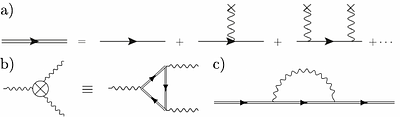
The magnetospheres of magnetars, a class of highly magnetized neutron stars, host magnetic fields exceeding the Schwinger limit, where Quantum Electrodynamics (QED) becomes nonlinear. In such environments, QED scattering processes are strongly modified, which may affect plasma dynamics. In this work, we apply a formalism originally developed for the study of magnetic-field effects in hot quark-gluon plasma to strong-field QED. The method resu... more
The magnetospheres of magnetars, a class of highly magnetized neutron stars, host magnetic fields exceeding the Schwinger limit, where Quantum Electrodynamics (QED) becomes nonlinear. In such environments, QED scattering processes are strongly modified, which may affect plasma dynamics. In this work, we apply a formalism originally developed for the study of magnetic-field effects in hot quark-gluon plasma to strong-field QED. The method resums interactions between virtual electrons and the external magnetic field, consistently incorporating the finite decay widths of excited Landau levels derived from the fermion self-energy. Using this framework, we perform the first systematic analysis of tree-level QED scattering processes in strong magnetic fields, concentrating on the processes of highest relevance for the plasma dynamics of magnetars. All resulting cross sections are provided in an open-source Python package. less
By: Jorge Terol Calvo, Marco Taoso, Andrea Caputo, Michela Negro, Marco Regis
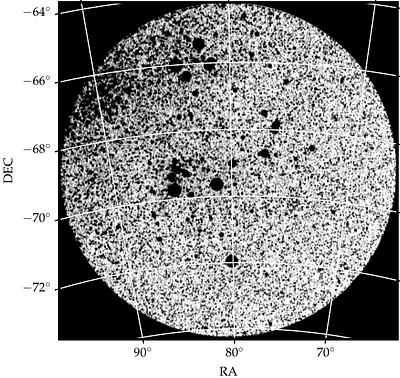
We perform a search for an X-ray monochromatic line arising from dark matter (DM) decay in the halo of the Large Magellanic Cloud. An emission line can be expected from two well-motivated DM candidates: sterile neturinos and axion-like particles (ALPs). We analyze the eROSITA-DE DR1 datasets in the energy range between 1 and 9 keV. No evidence for a DM line is found, and we set lower limits on the DM lifetime. We then recast these bounds into... more
We perform a search for an X-ray monochromatic line arising from dark matter (DM) decay in the halo of the Large Magellanic Cloud. An emission line can be expected from two well-motivated DM candidates: sterile neturinos and axion-like particles (ALPs). We analyze the eROSITA-DE DR1 datasets in the energy range between 1 and 9 keV. No evidence for a DM line is found, and we set lower limits on the DM lifetime. We then recast these bounds into upper limits on the active-sterile neutrino mixing angle $\sin^2(2θ)$ and on the ALP to photon coupling $g_{aγ}$, for DM masses between 2 and 18 keV. These results set new strong constraints for masses below 5 keV. less
By: Javier Rubio
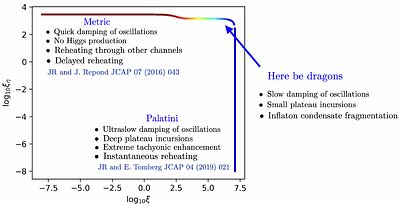
We review recent progress in the understanding of the preheating stage of Higgs inflation formulated within the Einstein-Cartan framework of gravity. This setup smoothly interpolates between the metric and Palatini formulations of the theory, leading to a distinctive phenomenology in an intermediate regime. Following the end of inflation, the Higgs field undergoes a non-trivial out-of-equilibrium evolution driven by tachyonic instabilities an... more
We review recent progress in the understanding of the preheating stage of Higgs inflation formulated within the Einstein-Cartan framework of gravity. This setup smoothly interpolates between the metric and Palatini formulations of the theory, leading to a distinctive phenomenology in an intermediate regime. Following the end of inflation, the Higgs field undergoes a non-trivial out-of-equilibrium evolution driven by tachyonic instabilities and nonlinear self-interactions, which fragment the inflaton condensate and give rise to well-localized oscillon configurations. While early studies suggested the formation of long-lived oscillons and the possibility of an extended matter-dominated phase, more recent analyses show that self-interactions at small field values render these objects transient, eventually triggering their decay and the onset of radiation domination. We discuss the implications of this dynamics for the thermal history of the Universe, the inflationary observables, and the generation of stochastic gravitational waves. less
By: Katarina Bleau, Joachim Kopp, Jiheon Lee, Jorinde van de Vis
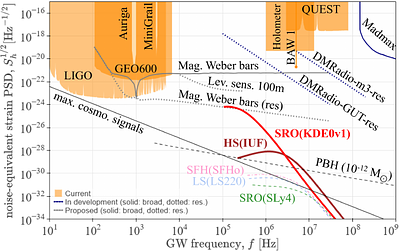
Tentative evidence suggests that the cores of massive neutron stars consist of deconfined quark matter. We argue that the formation of such a quark matter core during a galactic supernova could be accompanied by the emission of gravitational waves in the MHz band. These signals constitute a new target for high-frequency gravitational wave detectors, demonstrating that such detectors may offer unique opportunities for testing quantum chromodyn... more
Tentative evidence suggests that the cores of massive neutron stars consist of deconfined quark matter. We argue that the formation of such a quark matter core during a galactic supernova could be accompanied by the emission of gravitational waves in the MHz band. These signals constitute a new target for high-frequency gravitational wave detectors, demonstrating that such detectors may offer unique opportunities for testing quantum chromodynamics in an otherwise inaccessible regime. less
By: Victor P. Goncalves, Emmanuel Moulin, Igor Reis, Aion Viana
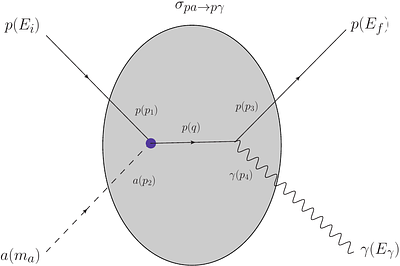
The production of very-high-energy (VHE, $E_γ \gtrsim 100$ GeV) gamma rays resulting from the scattering of high-energy cosmic-ray protons off axion-like particles (ALPs) populating the dark matter halo of the Milky Way is investigated. By employing the latest instrument response functions for current and future facilities, we demonstrate that ground-based VHE gamma-ray observatories, such as H.E.S.S., CTAO, and SWGO, provide a promising and ... more
The production of very-high-energy (VHE, $E_γ \gtrsim 100$ GeV) gamma rays resulting from the scattering of high-energy cosmic-ray protons off axion-like particles (ALPs) populating the dark matter halo of the Milky Way is investigated. By employing the latest instrument response functions for current and future facilities, we demonstrate that ground-based VHE gamma-ray observatories, such as H.E.S.S., CTAO, and SWGO, provide a promising and complementary avenue to probe the yet uncharted ALP-proton coupling $g_{ap}$. Our results show that these experiments can reach sensitivity to couplings above $10^{-2}$ in the $1 - 10^{8}$ eV ALP mass range, a region that remains largely unexplored by supernova and neutron star cooling observations. Interestingly, we demonstrate that this search channel is capable of probing QCD axion dark matter models, assuming two benchmark models for it: the Kim-Shifman-Vainshtein-Zakharov (KSVZ) Dine-Fischler-Srednicki-Zhitnitsky (DFSZ) models, specifically within the MeV mass range. These findings highlight the potential of VHE gamma-ray astronomy to provide unique constraints on the interaction between ALPs and the baryonic sector. less
By: Di Wu, Yifan Hu, Kohei Kamada
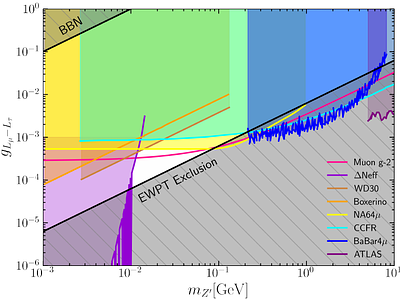
The generation of helical magnetic fields and the associated chiral asymmetry via the chiral anomaly is a generic feature in pseudoscalar inflation. In the presence of a Chern--Simons coupling between the inflaton and a U(1) gauge field, the homogeneous evolution of the inflaton induces a tachyonic instability in one circular polarization of the gauge field, resulting in the production of helical magnetic fields. In this work, we show that, i... more
The generation of helical magnetic fields and the associated chiral asymmetry via the chiral anomaly is a generic feature in pseudoscalar inflation. In the presence of a Chern--Simons coupling between the inflaton and a U(1) gauge field, the homogeneous evolution of the inflaton induces a tachyonic instability in one circular polarization of the gauge field, resulting in the production of helical magnetic fields. In this work, we show that, in the case of a gauged lepton flavor symmetry, U(1)$_{L_i-L_j}$, this mechanism can lead to the generation of a sizable lepton asymmetry. In a simple setup, however, the resulting lepton asymmetry is typically too small to have an observational consequences, even setting aside constraints from baryon overproduction via sphaleron processes, due to the backreaction of the produced gauge fields and fermions on the inflationary dynamics. We demonstrate that this limitation can be overcome by implementing a mechanism to suppress fermion production during inflation. As a result, a much larger lepton asymmetry can be generated from the subsequent decay of magnetic helicity. Remarkably, for the gauged U(1)$_{L_μ-L_τ}$ symmetry, the generated asymmetry can be sufficiently large to suppress the primordial helium abundance, as may be inferred from recent cosmic microwave background observations by ACT. less
The Lifespan of our Universe
0upvotes
By: Hoang Nhan Luu, Yu-Cheng Qiu, S. -H. Henry Tye
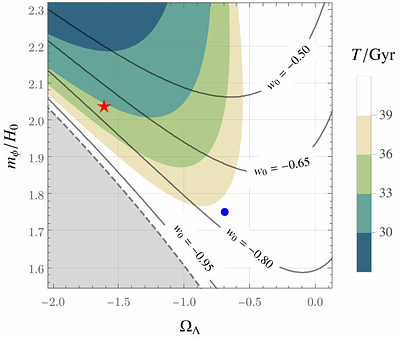
The Dark Energy Survey (DES) and the Dark Energy Spectroscopic Instrument (DESI) measurements claim that the dark energy equation of state $w \ne -1$. This observation can be explained by the axion Dark Energy (aDE) model of an ultralight axion plus a cosmological constant $\Lambda$. Despite a relatively large degeneracy, there is a high probability that $\Lambda <0$. This negative $\Lambda$ leads the universe to end in a big crunch. Using th... more
The Dark Energy Survey (DES) and the Dark Energy Spectroscopic Instrument (DESI) measurements claim that the dark energy equation of state $w \ne -1$. This observation can be explained by the axion Dark Energy (aDE) model of an ultralight axion plus a cosmological constant $\Lambda$. Despite a relatively large degeneracy, there is a high probability that $\Lambda <0$. This negative $\Lambda$ leads the universe to end in a big crunch. Using the best-fit values of the model as a benchmark, we find the lifespan of our universe to be 33 billion years. less

By: Ya-Ru Wang, Shu-Jun Rong
Gravitational lensing is a powerful tool to probe compact astrophysical objects and the distribution of dark matter at large scales. As a counterpart of photons, lensed relativistic neutrinos could also be used to explore properties of curved spacetimes. In the present paper we consider neutrino oscillations in the Ellis wormhole (WH) spacetime in comparison with the widely discussed black hole (BH) spacetimes. We investigate the oscillations... more
Gravitational lensing is a powerful tool to probe compact astrophysical objects and the distribution of dark matter at large scales. As a counterpart of photons, lensed relativistic neutrinos could also be used to explore properties of curved spacetimes. In the present paper we consider neutrino oscillations in the Ellis wormhole (WH) spacetime in comparison with the widely discussed black hole (BH) spacetimes. We investigate the oscillations involving lensing effects with 2- and 3-flavor neutrinos under the weak-field approximation. In the two-flavor model, the flavor oscillation probabilities display the impacts of the throat radius, neutrino mass hierarchy, and the lightest neutrino mass. In the realistic 3-flavor case, the similar observations are obtained with the up-to-date global fit data of neutrino experiments. The influence of the Ellis WH on the coherence of neutrinos is also studied in the paper. In general, the observations from neutrino oscillations cannot be used to discriminate Ellis WH spacetimes from typical BH spacetimes under the weak-field limit. less
By: Yen-Hsun Lin, Meng-Ru Wu
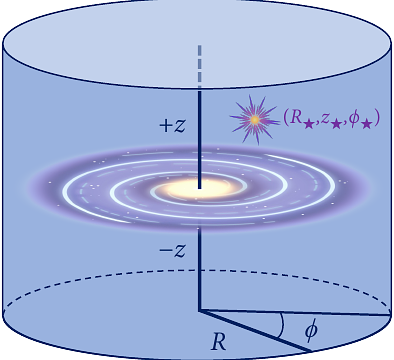
Supernova-neutrino-boosted dark matter (SN$\nu$ BDM) has emerged as a promising portal for probing sub-GeV dark matter. In this work, we investigate the behavior of BDM signatures originating from core-collapse supernovae (CCSNe) within the Milky Way (MW) over the past one hundred thousand years, examining both their temporal evolution and present-day spatial distributions. We show that while the MW BDM signature is approximately diffuse in t... more
Supernova-neutrino-boosted dark matter (SN$\nu$ BDM) has emerged as a promising portal for probing sub-GeV dark matter. In this work, we investigate the behavior of BDM signatures originating from core-collapse supernovae (CCSNe) within the Milky Way (MW) over the past one hundred thousand years, examining both their temporal evolution and present-day spatial distributions. We show that while the MW BDM signature is approximately diffuse in the nonrelativistic regime, it exhibits significant temporal variation and spatial localization when the BDM is relativistic. Importantly, we compare these local MW signatures with the previously proposed diffuse SN$\nu$ BDM (DBDM), which arises from the accumulated flux of all past SNe in the Universe [Y.-H. Lin and M.-R. Wu, Phys. Rev. Lett. 133, 111004 (2024)]. In the nonrelativistic limit, DBDM consistently dominates over the local diffuse MW BDM signature. Only when the MW BDM becomes ultrarelativistic and transitions into a transient, highly-localized signal, it can potentially surpass the DBDM background. This work thus reinforces the importance of DBDM for SN$\nu$ BDM searches until the next galactic SN offers new opportunities. less