Squeezed Diffusion Models

Squeezed Diffusion Models
Jyotirmai Singh, Samar Khanna, James Burgess
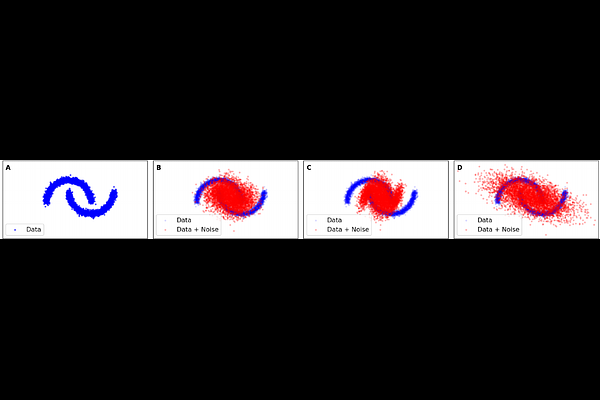
AbstractDiffusion models typically inject isotropic Gaussian noise, disregarding structure in the data. Motivated by the way quantum squeezed states redistribute uncertainty according to the Heisenberg uncertainty principle, we introduce Squeezed Diffusion Models (SDM), which scale noise anisotropically along the principal component of the training distribution. As squeezing enhances the signal-to-noise ratio in physics, we hypothesize that scaling noise in a data-dependent manner can better assist diffusion models in learning important data features. We study two configurations: (i) a Heisenberg diffusion model that compensates the scaling on the principal axis with inverse scaling on orthogonal directions and (ii) a standard SDM variant that scales only the principal axis. Counterintuitively, on CIFAR-10/100 and CelebA-64, mild antisqueezing - i.e. increasing variance on the principal axis - consistently improves FID by up to 15% and shifts the precision-recall frontier toward higher recall. Our results demonstrate that simple, data-aware noise shaping can deliver robust generative gains without architectural changes.