Systematic analysis of RhoGAP expression and function in border cell morphology and migration

Systematic analysis of RhoGAP expression and function in border cell morphology and migration
Mishra, A. K.; Gemmil, E.; Campanale, J. P.; Mondo, J.; Lisi, V.; Kosik, K. S.; Montell, D. J.
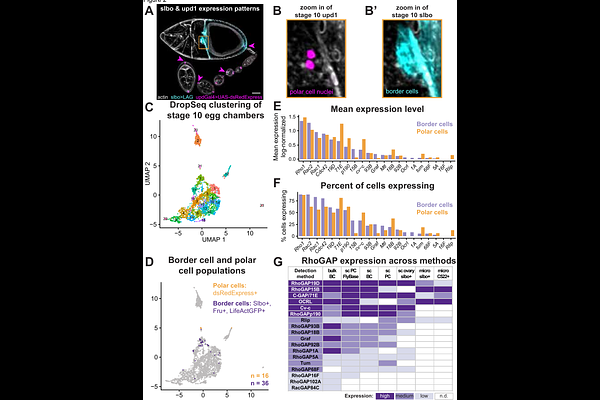
AbstractRho family GTPases are central hubs in the signaling and cytoskeletal networks that govern cell morphology and behavior. GTPase-activating proteins (GAPs) inactivate them by accelerating GTP hydrolysis. However, a systematic analysis of GAPs in cell migration is lacking. Here, we report screens for RhoGAP expression and function in migratory Drosophila border cells. Constitutively active Cdc42, Rac, or Rho causes defects, demonstrating that negative regulation is critical. Integrating single-cell RNAseq with published datasets reveals that most of the 22 RhoGAPs are expressed in border cells. RNAi knockdown shows most RhoGAPs are functionally required. We developed automated image analysis tools to sensitively and objectively classify border cell morphologies, defining a normal morphological phase space. RhoGAP perturbations push clusters outside this range. In-depth analysis of RhoGAPp190 reveals that loss-of-function resembles Rho hyperactivation and gain-of-function resembles myosin II inhibition. Thus, complex spatiotemporal sculpting of RhoGTPase activities requires diverse RhoGAPs within a single cell type to control morphology and motility in vivo.