Exploring the effect of mixing in Low-Luminosity Type IIp Supernovae by modeling SN 2024abfl

Exploring the effect of mixing in Low-Luminosity Type IIp Supernovae by modeling SN 2024abfl
Akshith Karri, Abigail Polin, Paul Duffell
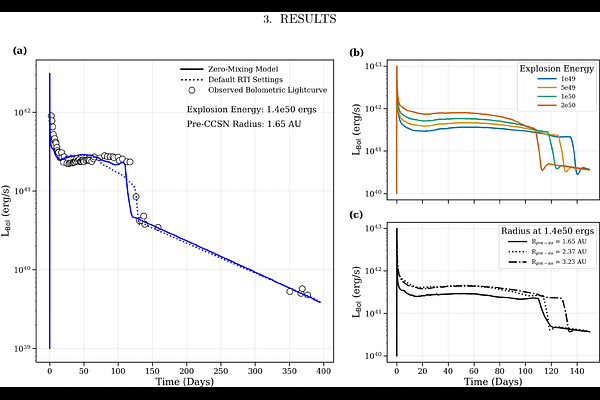
AbstractLow-luminosity Type IIp supernovae (LLSNe) are SN IIps with peak magnitudes > -15.5 and plateau magnitudes between -13.5 and -15.5 in the V band. SN 2024abfl is an LLSN with a unique light curve, particularly the steep drop in luminosity observed after the plateau phase makes it an interesting candidate for modeling core-collapse supernova mechanisms. Using a custom pipeline involving MESA and STELLA, we investigate the possibility of suppressed ejecta mixing as a cause of the steep drop-off from the plateau phase. We find that turning off mixing mechanisms during shock breakout can mimic the distinct flat plateau and steep luminosity drop into the radioactive tail of the light curve while using previously proposed progenitor mass, radius and explosion energy parameters. Using these results as a proof-of-concept, exploring the effects of limited mixing in LLSNe candidates could give us better insight into how they differ from Typical Type IIp SNe.