Spligation enables programmable chimeric RNA generation in living cells

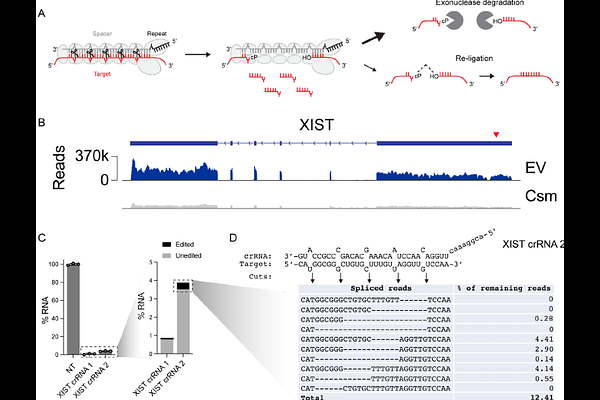
Spligation enables programmable chimeric RNA generation in living cells
Colognori, D.; Wasko, K. M.; Trinidad, M. I.; Zhou, Z.; Doudna, J. A.
AbstractThe ability to precisely modify RNA offers opportunities to manipulate the flow of genetic information and influence transcript stability, localization and translation. RNA-targeting technologies enable RNA knockdown, base editing and trans-splicing, but more extensive transcript changes typically require genome editing or rely on the endogenous splicing machinery. Based on the ability of type III-A CRISPR-Csm complexes to catalyze programmable RNA cleavage in human cells, we investigated their potential to induce site-specific deletions while leaving the remainder of the transcript intact. Our data show that CRISPR-Csm complexes can generate short and long RNA excisions within a target transcript, and that the efficiency of this process is enhanced by fusion of Csm to the RNA ligase RtcB. Furthermore, cleavage of two different transcripts can trigger subsequent trans-ligation of the cleaved products into a chimeric transcript ("spligation"). Finally, we apply spligation to endogenous transcripts, using Csm to generate recombinant mRNA in cells independent of canonical splice sites. Collectively, this approach enables new forms of precise RNA manipulation in cells with potential applications in human disease.