Bistable attractor dynamics in difficult-to-treat rheumatic disease: a multi-axis ODE framework with cross-disease transcriptomic evidence

Bistable attractor dynamics in difficult-to-treat rheumatic disease: a multi-axis ODE framework with cross-disease transcriptomic evidence
jung, s.; jeong, h.; jeon, C. H.
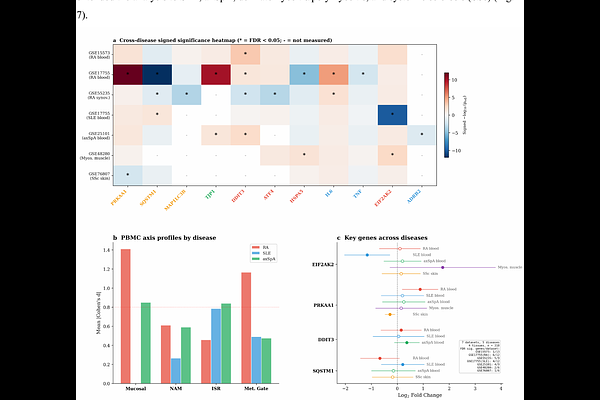
AbstractDifficult-to-treat (D2T) rheumatic disease affects approximately 12% of rheumatoid arthritis patients and resists sequential biologic therapy, yet no mechanistic model explains this refractoriness as a system-level phenomenon. Here we present the 3-Axis Integrative Framework (3-AIF), a six-variable ordinary differential equation system integrating mucosal tolerance, energy-gated neuroimmune danger sensing, and integrated stress response pathways coupled through Hill-function metabolic gating. Stability analysis reveals bistable dynamics with two co-existing attractors separated by a saddle point. Bifurcation analysis demonstrates fold catastrophe with hysteresis: recovery requires greater therapeutic effort than disease prevention. Sensitivity analysis identifies three dominant parameters mapping to neuroimmune activation, energy drain, and recovery capacity. Cross-disease transcriptomic consistency analysis across six public datasets (n=310, five rheumatic diseases, four tissue types) reveals compartment-specific axis dysregulation circulating cells show integrated stress response activation while target tissues show pathway exhaustion and disease-specific axis dominance patterns consistent with model predictions.