AT2019ijn: a fast-rising, slow-decaying blue optical transient with exceptionally bright radio emission

AT2019ijn: a fast-rising, slow-decaying blue optical transient with exceptionally bright radio emission
Hucheng Ding, Xinwen Shu, Luming Sun, Liangduan Liu, Lei Yang, Yunwei Yu, Xueguang Zhang, Ying Gu, Fangkun Peng, Fabao Zhang, Zhumao Zhang, Ningyu Tang
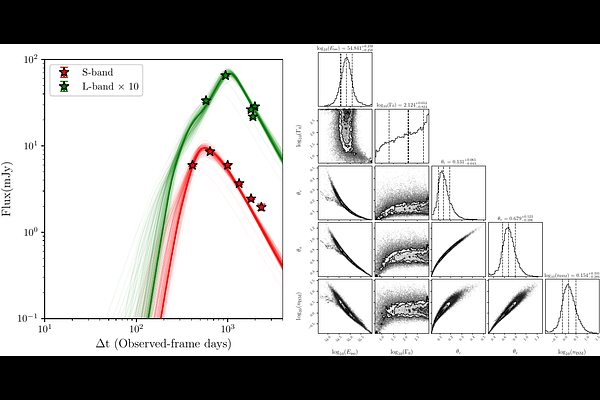
AbstractWe report the discovery of a peculiar optical transient, AT2019ijn, occurred in the nuclear region of a dwarf galaxy at z=0.273. It rises rapidly to peak at a luminosity of Mg=-21.1 in 5 days, followed by a slow decline over more than a month, during which the optical emission has a persistently high blackbody temperature of T_BB~1.5-1.6x10^4 K. The radio emission is exceptional which peaks at 640 days after optical discovery with a high luminosity of 2x10^31 erg/s/Hz. The peak radio luminosity is at least two orders of magnitude brighter than known radio-bright fast blue optical transients and supernova explosions at similar epochs, but comparable to jetted tidal disruption events. The luminous and long-lasting radio emission with a late-time peak can be explained by an off-axis relativistic jet with a viewing angle of ~40 deg. We discuss possible origins for AT2019ijn and favor a jetted tidal disruption event involving an intermediate-mass black hole of ~10^5 Msun, although a jetted magnetar model cannot be fully ruled out. AT2019ijn represents a new class of relativistic optical transients that highlights the importance of radio surveys for discovering off-axis jetted events.