Dispersal rate limits range expansion rate only when it is slower than climate velocity

Dispersal rate limits range expansion rate only when it is slower than climate velocity
Moore, N. A.; Lenoir, J. A.; Comte, L.; Lawlor, J. A.; Sunday, J. M.
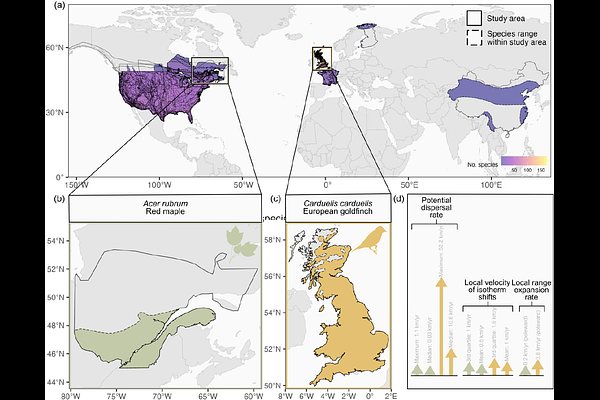
AbstractLow dispersal ability might limit a species' capacity to track its climate preferences across the landscape, yet evidence that low dispersal slows species' range shifts under contemporary climate change remains contentious. Here we develop a new hypothesis under which we expect variation in dispersal ability to affect range expansion rates only when climate velocity exceeds dispersal rates, which is logical yet rarely applied because it requires a common yardstick to compare rates. We test this hypothesis using empirical relationships between dispersal ability, local range expansion rate, and the velocity of isotherm shifts in terrestrial plants and birds, all estimated in km/yr. In 370 range shifts, we found that range expansion rates were best explained by the slower of either a species' dispersal rate or the velocity of isotherm shifts, as predicted under our hypothesis. Furthermore, when species' dispersal rates were slower than the velocity of isotherm shifts, we found that dispersal ability positively affects range shift rates. Substantial variation in range expansion rates remained unexplained, indicating that additional factors influence range shift dynamics. Our results provide new clarity when understanding the role of dispersal ability on variation in range shift rates and emphasize the importance of evaluating dispersal capacity relative to climatic change exposure when testing hypotheses about species' responses to ongoing environmental change.