Toxoplasma TgATG2 works with TgATG9 and TgProp1 to drive autophagic flux for parasite extracellular survival and persistence.

Toxoplasma TgATG2 works with TgATG9 and TgProp1 to drive autophagic flux for parasite extracellular survival and persistence.
Masci, S.; Thaprawat, P.; Piro, F.; Schultz, T. L.; Carruthers, V. B.; Di Cristina, M.
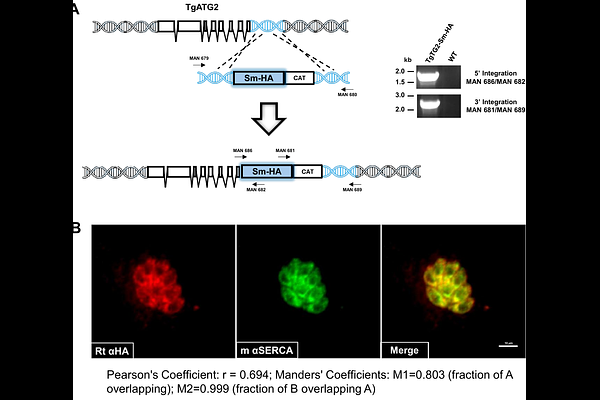
AbstractChronic infection by Toxoplasma gondii depends on long-term survival of bradyzoites within tissue cysts, a parasite stage highly resistant to current therapies and a major barrier to eradication. Autophagy has emerged as critical pathway for bradyzoite persistence, yet the core machinery driving autophagosome formation in T. gondii remains poorly defined. Here, we identify TGME49_304630 as TgATG2, a previously uncharacterized, unusually large ATG2-like protein with conserved structural features of lipid-transfer factors. TgATG2 associates with TgATG9 and TgPROP1, key components of the parasite autophagy pathway, supporting its role in a membrane expansion complex required for autophagosome biogenesis. Using independent genetic knockouts, we show that TgATG2 is dispensable for intracellular tachyzoite replication but required for parasite fitness during extracellular stress and, most critically, for bradyzoite autophagy and viability. TgATG2 ablation disrupts autophagic activity in bradyzoites, causing progressive loss of viability and compromised cyst integrity. To overcome limitations of previous indirect assays, we developed a bradyzoite-specific dual-fluorescence TgATG8 reporter that quantitatively measures autophagic flux in T. gondii and confirmed TgATG2 as a major contributor. Importantly, TgATG2-deficient parasites are severely impaired during chronic infection in mice, with reduced brain cyst burdens, abnormal cyst morphology, and markedly diminished ex vivo bradyzoite viability. Together, these findings establish TgATG2 as a central component of the T. gondii autophagy machinery, demonstrate that autophagosome biogenesis is critical for parasite persistence in vivo, and define a molecular vulnerability and quantitative platform for targeting autophagy-dependent parasite survival.