Instruction set for the representation of graphs

Instruction set for the representation of graphs
Ezequiel Lopez-Rubio, Mario Pascual-Gonzalez
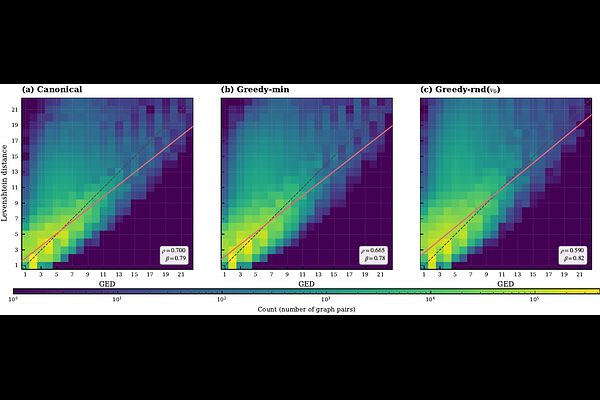
AbstractWe present IsalGraph, a method for representing the structure of any finite, simple graph as a compact string over a nine-character instruction alphabet. The encoding is executed by a small virtual machine comprising a sparse graph, a circular doubly-linked list (CDLL) of graph-node references, and two traversal pointers. Instructions either move a pointer through the CDLL or insert a node or edge into the graph. A key design property is that every string over the alphabet decodes to a valid graph, with no invalid states reachable. A greedy \emph{GraphToString} algorithm encodes any connected graph into a string in time polynomial in the number of nodes; an exhaustive-backtracking variant produces a canonical string by selecting the lexicographically smallest shortest string across all starting nodes and all valid traversal orders. We evaluate the representation on five real-world graph benchmark datasets (IAM Letter LOW/MED/HIGH, LINUX, and AIDS) and show that the Levenshtein distance between IsalGraph strings correlates strongly with graph edit distance (GED). Together, these properties make IsalGraph strings a compact, isomorphism-invariant, and language-model-compatible sequential encoding of graph structure, with direct applications in graph similarity search, graph generation, and graph-conditioned language modelling