Dynamics and control of highly pathogenic H5 avian influenza in a threatened pelican population

Dynamics and control of highly pathogenic H5 avian influenza in a threatened pelican population
Yang, Q.; Alexandrou, O.; Höfle, U.; Minayo-Martin, S.; Chaintoutis, S. C.; Moutou, E.; Dovas, C. I.; Moncla, L. H.; Grenfell, B. T.; Catsadorakis, G.
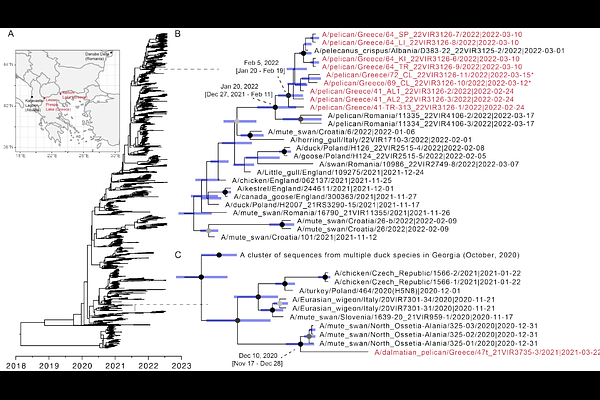
AbstractThe ongoing epizootic of highly pathogenic avian influenza (HPAI) continues to cause massive deaths in wildlife. Fundamental understanding of its disease ecology in natural populations is urgently needed. This knowledge has been hindered by the difficulty of acquiring data on epidemic dynamics. Here, using data collected from a threatened population of Dalmatian pelicans (Pelecanus crispus), we recover the epidemiological and evolutionary history of one of the largest HPAI wildlife mortality events. The results show that this devastating outbreak was likely seeded by a single introduction associated with movement of the species. By estimating epidemiological features of two consecutive outbreaks in the same population, we show that panzootic H5N1 since 2022 likely exhibits higher transmissibility and longer shedding time in non-reservoir birds, compared to previous H5NX subtypes. We also evaluate effectiveness of past and future control measures: carcass removal during the outbreak is shown to have surprisingly little impact on mitigating the mortality; and current H5 vaccines relying on capture and injection to deliver cannot establish herd immunity in a wildlife population. The results provide the first field evidence supporting the hypothesis that viral fitness difference of H5N1 to previous H5NX subtypes is the key cause of the expanded epizootic and panzootic since 2022, and on highly debated HPAI management strategies in wildlife populations.