First-Principles Turbulence-Driven Deflagration-to-Detonation Transition Mechanism for Near-Chandrasekhar Mass White Dwarf Progenitors

First-Principles Turbulence-Driven Deflagration-to-Detonation Transition Mechanism for Near-Chandrasekhar Mass White Dwarf Progenitors
Krut Patel, Akshay Dongre, Robert Fisher, Alexei Poludnenko, Vadim Gamezo, Mark Ugalino, Chris Byrohl
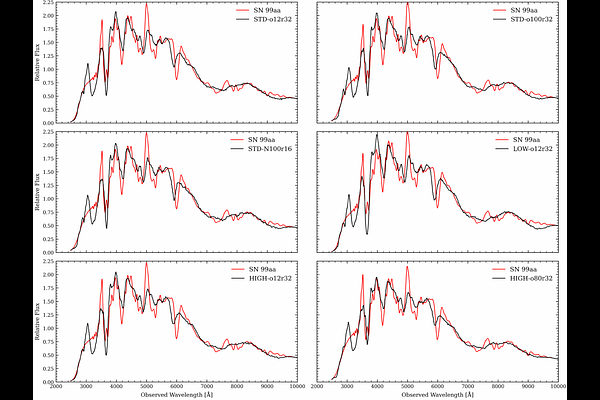
AbstractType Ia supernovae (SNe Ia) play an important role throughout astrophysics, most notably as standardizable cosmological candles. Yet, their stellar progenitors and explosion mechanism remain areas of active investigation. For decades, the canonical model for normal brightness SNe Ia used in cosmology was a carbon-oxygen white dwarf (WD) accreting from a non-degenerate stellar companion, approaching the Chandrasekhar mass (M_Ch). Previously, all models of near-M_Ch SNe Ia invoked an ad hoc assumption on the critical process of detonation initiation, and could therefore be tuned to a variety of outcomes. Here, we present global 3D hydrodynamical simulations of near-M_Ch progenitors, which incorporate, for the first time, a laboratory-validated ab initio mechanism for the turbulence-driven deflagration-to-detonation transition (tDDT). The tDDT detonation mechanism is highly efficient, leading to detonation initiation which is prompt in comparison to most prior work. Despite spanning a factor of six in central ignition density and qualitatively distinct ignition topologies, all models converge on nearly identical synthetic spectra at peak luminosity, spectroscopically matched to the overluminous SN 1999aa. The turbulence-driven Chapman-Jouguet criterion drives each progenitor to a common detonation configuration from diverse initial conditions, providing a physical foundation for the ignition-insensitive detonation outcomes implicit in the empirical standardizability of SNe Ia. This provides the first physically motivated, self-consistent pathway for delayed detonation in SNe Ia simulations. Further work is necessary to understand how this mechanism might produce more delayed detonation initiation and potentially fail, thereby yielding SNe Iax.