The Last Human-Written Paper: Agent-Native Research Artifacts

The Last Human-Written Paper: Agent-Native Research Artifacts
Jiachen Liu, Jiaxin Pei, Jintao Huang, Chenglei Si, Ao Qu, Xiangru Tang, Runyu Lu, Lichang Chen, Xiaoyan Bai, Haizhong Zheng, Carl Chen, Zhiyang Chen, Haojie Ye, Yujuan Fu, Zexue He, Zijian Jin, Zhenyu Zhang, Shangquan Sun, Maestro Harmon, John Dianzhuo Wang, Jianqiao Zeng, Jiachen Sun, Mingyuan Wu, Baoyu Zhou, Yuchen You, Shijian Lu, Yiming Qiu, Fan Lai, Yuan Yuan, Yao Li, Junyuan Hong, Ruihao Zhu, Beidi Chen, Alex Pentland, Ang Chen, Mosharaf Chowdhury, Zechen Zhang
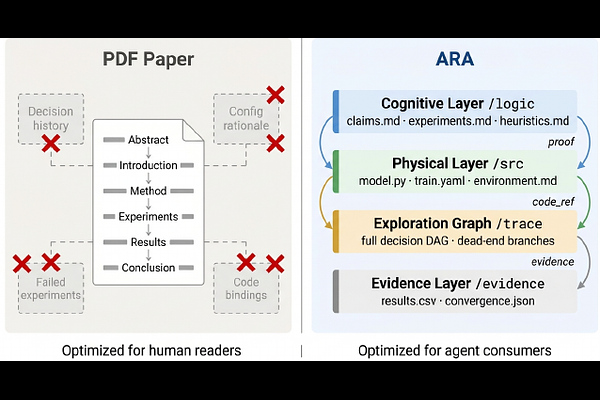
AbstractScientific publication compresses a branching, iterative research process into a linear narrative, discarding the majority of what was discovered along the way. This compilation imposes two structural costs: a Storytelling Tax, where failed experiments, rejected hypotheses, and the branching exploration process are discarded to fit a linear narrative; and an Engineering Tax, where the gap between reviewer-sufficient prose and agent-sufficient specification leaves critical implementation details unwritten. Tolerable for human readers, these costs become critical when AI agents must understand, reproduce, and extend published work. We introduce the Agent-Native Research Artifact (Ara), a protocol that replaces the narrative paper with a machine-executable research package structured around four layers: scientific logic, executable code with full specifications, an exploration graph that preserves the failures compilation discards, and evidence grounding every claim in raw outputs. Three mechanisms support the ecosystem: a Live Research Manager that captures decisions and dead ends during ordinary development; an Ara Compiler that translates legacy PDFs and repos into Aras; and an Ara-native review system that automates objective checks so human reviewers can focus on significance, novelty, and taste. On PaperBench and RE-Bench, Ara raises question-answering accuracy from 72.4% to 93.7% and reproduction success from 57.4% to 64.4%. On RE-Bench's five open-ended extension tasks, preserved failure traces in Ara accelerate progress, but can also constrain a capable agent from stepping outside the prior-run box depending on the agent's capabilities.