Validating wing biopsies for blood-borne pathogen characterization in bats

Validating wing biopsies for blood-borne pathogen characterization in bats
Simonis, M. C.; Vicente-Santos, A. C.; Lock, L. R.; Dyer, K. E.; Olbrys, B. L.; Fenton, B.; Sears, K. E.; Volokhov, D. V.; Simmons, N. B.; Becker, D.
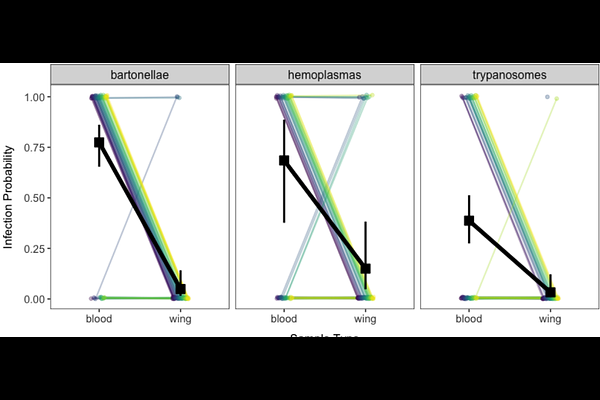
AbstractWildlife surveillance is critical for tracking disease emergence, characterizing pathogen diversity, and assessing spillover risks. Blood-borne pathogens are of particular interest for such efforts due to their global distribution, broad host taxa, and zoonotic potential. Despite the need to monitor blood-borne pathogens, blood collection efforts are costly for both biologists and the wildlife being sampled (i.e., time-consuming and stressful), hindering our ability to expand and enhance surveillance efforts. There is thus a pressing need for reliable methods for detecting blood-borne pathogens that minimize sampling efforts and wildlife stress. Vascular tissues can contain enough blood to detect infections while minimizing sampling effort and stress on wildlife, but it is unclear how pathogen detection and characterization from these tissues compared to blood. To evaluate the reliability of using vascular tissues for detecting blood-borne pathogens in wildlife, we collected paired samples of blood and wing biopsies from individual common vampire bats (Desmodus rotundus) and molecularly screened them for bartonellae, hemotropic mycoplasmas (hemoplasmas), and trypanosomes. The probability of detection was consistently lower in wing tissues than in blood for all pathogens, possibly due to blood vessel avoidance when collecting the former. However, we detected infection in wing tissues of at least two individual bats for each blood-borne pathogen. Paired-positive individuals mostly showed high sequence concordance between tissues, indicating frequent detection of the same infections. Estimated sample sizes needed to detect a single infection and the reported prevalences were similar (i.e., n = 10-39). Due to the lower probability of infection in wing tissues compared to blood, we suggest that using these samples to estimate infection prevalence of blood-borne pathogens is not ideal. However, our results demonstrate that vascular tissues are viable for initial pathogen assessment and discovery to help target surveillance efforts in the future.