Slow Oscillatory Transcranial Direct Current Stimulation during a Restricted Sleep Opportunity Enhances Cognitive Performance during Subsequent Wakefulness

Slow Oscillatory Transcranial Direct Current Stimulation during a Restricted Sleep Opportunity Enhances Cognitive Performance during Subsequent Wakefulness
Hughes, J. D.; Doty, T. J.; Balkin, T. J.
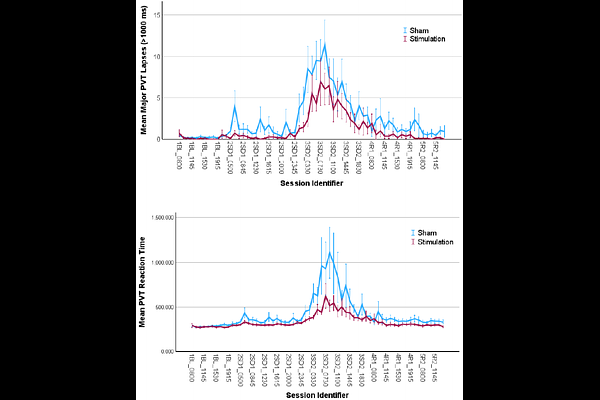
AbstractThe slow oscillation (SO) of non-rapid eye movement (NREM) sleep has been implicated in the restorative properties of sleep. Slow oscillatory transcranial direct current stimulation (SO-tDCS), involving a positive oscillatory current applied to the scalp at a peak frequency of 0.75 Hz, has been used to enhance SO power during NREM sleep. We examined whether enhancing SO power with SO-tDCS during a restricted nighttime sleep opportunity would accelerate the restorative properties of sleep during an otherwise insufficient sleep period and help sustain performance during subsequent extended wakefulness. A total of twenty-six healthy young adults (ages 18-39, n=16 females) completed a 15-day study. After 7 baseline nights at home and 3 baseline nights in the laboratory, participants entered the laboratory for 5 consecutive days including a baseline day, a 2-hour nighttime sleep period with participants randomized to the SO-tDCS (n=11) or SHAM (n=15) condition, 46 hours of sleep deprivation, and two recovery nights. In the SO-tDCS condition, stimulation was administered for one hour starting exactly 60 minutes after sleep onset, with intervals of five minutes of continuous stimulation followed by one minute of no stimulation. Polysomnographic recordings were conducted during each sleep period. Performance was assessed using the Psychomotor Vigilance Test (PVT) approximately every 75 minutes across baseline, sleep deprivation, and recovery. Prior to the two-hour sleep opportunity, a Paired Words Associate Task was administered. Participants listened to 54-word pairs and were asked to recall 46 of the word pairs, with up to three attempts to successfully recall at least 60% of word pairs (T0). Recall was also assessed 20- (T20) and 120-minutes (T120) after awakening from the two-hour sleep period. Data were analyzed using mixed-effects ANOVA. PVT performance (defined as mean response time and number of response times greater than 1,000 ms) significantly declined across sleep deprivation with performance degradations peaking in the early morning hours. Participants in the STIM condition demonstrated significantly better performance during sleep deprivation relative to the SHAM condition. On the PWAT, participants in the SHAM condition recalled fewer word-pairs upon awakening relative to T0. In sharp contrast, performance of participants in the SO-tDCS condition did not deteriorate at T20 and was actually improved at T120 relative to T0. We conclude that SO-tDCS can robustly accelerate the restorative properties of sleep and can additionally enhance sleep related memory consolidation when sleep opportunity is restricted.