Carbon limitation decouples roots but not leaves from nitrogen-fixing mutualists

Carbon limitation decouples roots but not leaves from nitrogen-fixing mutualists
Bartsch, L. J. R.; Leal, L. C.; Nogueira, A.
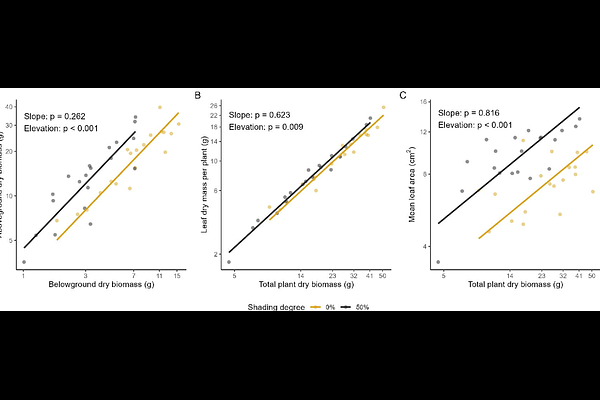
AbstractWhile mutualistic symbioses with nitrogen-fixing bacteria enable plants to access fixed nitrogen, they also require substantial carbon investment. Under carbon limitation, such as shading, shifts in biomass allocation can decouple symbiotic investment from leaf and root growth, potentially compromising plant nitrogen status. Because shading shifts biomass allocation toward light acquisition, it could influence nitrogen fixing symbiosis in two opposing ways. If nodulation remains coupled to leaves rather than roots, nitrogen status should be maintained despite reduced root growth. Alternatively, if root growth constrains nodulation, nitrogen status should decline. We tested these hypotheses by manipulating light availability (full sunlight vs. 50% shade) and quantifying biomass allocation and symbiotic nodulation. Under shading, plants allocated proportionally more biomass to shoots than to roots and invested less biomass in root nodules. Relationships between nodulation and leaf or root biomass differed between treatments but converged with increasing plant size, although shaded plants never attained the root biomass observed in full sunlight. Leaf nitrogen concentration was maintained under shading because nodulation remained coupled to leaf investment despite reduced root allocation. These findings highlight that, under carbon limitation, maintaining leaf and nodule coupling enables plants to reduce nodule investment without compromising the nitrogen benefits of symbiosis.