Endothelial adaptation to complex flow patterns in a novel in vitro model predicted by computational fluid dynamics

Endothelial adaptation to complex flow patterns in a novel in vitro model predicted by computational fluid dynamics
Spurgin, S. B.; Salimi, S.; Lee-Kim, V. S.; Pramanik, T.; Mettlen, M.; Sadat, H.; Cleaver, O.
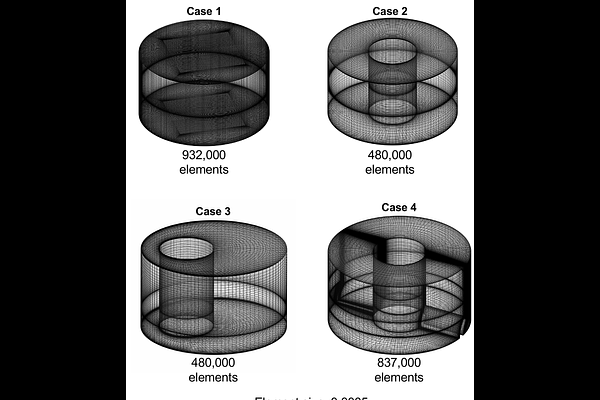
AbstractThe endothelial cells (ECs) that line blood vessels continuously sense and respond to the physical forces exerted by blood flow. In vivo, pulsatile arterial flow interacts with vessel curvature, branching and other anatomical features to generate complex local hemodynamic environments that dictate the magnitude, direction, pulsatility, and oscillatory nature of wall shear stress experienced by ECs. Currently, accessible and reproducible in vitro models of complex pulsatile flow that recapitulate in vivo vascular anatomy remain limited. Here, we combine a novel rotational-flow endothelial culture platform with detailed computational fluid dynamics (CFD) modeling to characterize four well geometries designed to generate distinct hemodynamic environments. CFD analyses demonstrate that these geometries intrinsically generate pulsatile flow and produce reproducible spatially distinct regions of wall shear stress magnitude, pulsatility, and oscillatory shear within a single culture well. Endothelial alignment mapping and functional assays reveal region-specific cellular responses to the predicted local flow conditions that closely corresponded to the predicted local hemodynamic environment, linking complex flow patterns to endothelial adaptation. The technical advancements of our modeling efforts should support a faster, cheaper, simpler, and--importantly--validated framework for future investigation into EC mechanobiology under complex flow conditions. HIGHLIGHTSO_LISimple engineered well geometries generate distinct hemodynamic microenvironments, mimicking in vivo vascular structures, using a conventional orbital shaker. C_LIO_LIComputational fluid dynamics (CFD) reveals spatially distinct patterns of wall shear stress, pulsatility, and oscillatory shear applied to ECs within individual culture wells. C_LIO_LIHigh average wall shear stress and elevated oscillatory shear index induces a unique perpendicular alignment of ECs to the dominant flow vector. C_LI