Cassava witches' broom disease in French Guiana: a threat to cacao cultivation and its biodiversity?

Cassava witches' broom disease in French Guiana: a threat to cacao cultivation and its biodiversity?
Sayadi Maazou, A.-R.; Doare, F.; Louisanna, E.; Vignes, H.; Tharreau, D.; Adreit, H.; Cayron, C.; Ten Hoopen, G. M.
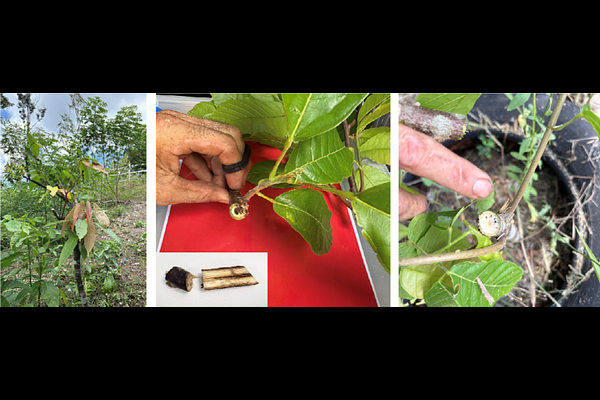
AbstractBeyond the significant impact of Cassava witches' broom disease (CWBD), caused by the fungus Rhizoctonia (syn. Ceratobasidium) theobromae on cassava cultivation in French Guiana and Brazil, this disease also poses a potential threat to cacao trees in the region, since the fungus is responsible for Vascular Streak Dieback (VSD) of cacao in South East Asia. Cross-pathogenicity trials were conducted in several cassava fields in French Guiana by planting young cacao plants adjacent to diseased cassava plants. Vascular necrosis was observed in some cacao plants, and the presence of R. theobromae in the cacao tissues was confirmed through PCR diagnostics using primers specific to the fungus. Sequence analysis indicated 100% similarity between samples from both hosts and 97.53 to 99.74% identity with R. theobromae isolates previously reported from cassava in the Americas and Southeast Asia. Additionally, symptomatic cacao in a mixed cacao-cassava farm yielded R. theobromae-positive PCR results, suggesting a natural infection. Ongoing work includes artificial inoculations and controlled cross-pathogenicity trials under screenhouse conditions to attempt reproduction of the symptoms. While current data do not yet establish definitive causality, the findings indicate potential host jump and warrant rapid communication to researchers, policy makers, and farmers to safeguard cacao production and Theobroma biodiversity in the Amazon region. Keywords: Theobroma cacao L., cassava witches' broom disease, Rhizoctonia theobromae, Ceratobasidium