Search for GeV gamma-ray emission from PSZ G181.06+48.47 galaxy cluster using Fermi-LAT data

Search for GeV gamma-ray emission from PSZ G181.06+48.47 galaxy cluster using Fermi-LAT data
Anuja Deshpande, Siddhant Manna, Shantanu Desai
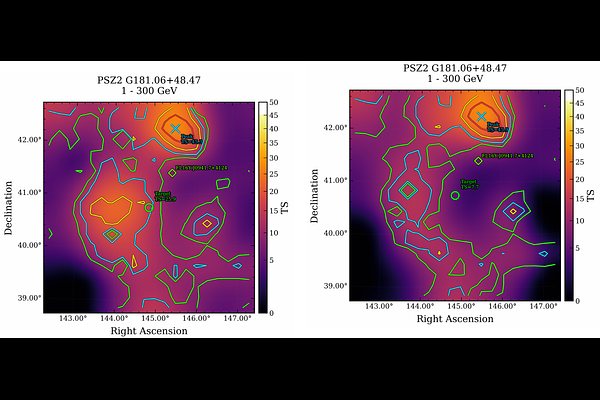
AbstractWe present a search for high energy gamma rays in the energy range from 1--300~GeV from the galaxy cluster PSZ2~G181.06+48.47 using 17.9~years of Fermi-LAT data. A binned likelihood analysis employing the 16-year source catalog reveals a significant $γ$-ray excess at the cluster position. Modelling the emission as a point source yields a detection with $\mathrm{TS}=19.0 (4.3 σ)$, a photon index of $Γ=3.20 \pm 0.62$, and an integrated photon flux of $(9.75\pm2.74)\times10^{-11}\,\mathrm{ph\,cm^{-2}\,s^{-1}}$, but leaves statistically significant residual emission at the cluster center. Replacing the point-source hypothesis with a RadialGaussian spatial template significantly improves the fit, with a preferred width of $σ=0.4^{\circ}$ and an extension significance of $\mathrm{TS}_{\rm ext}=36.8 (6.0σ)$. The adopted Gaussian model yields a source detection significance of $\mathrm{TS}=55.0 (7.4σ)$, a photon index of $Γ=2.62\pm0.26$, and an integrated photon flux of $(3.22\pm0.50)\times10^{-10}\,\mathrm{ph\,cm^{-2}\,s^{-1}}$, while reducing the residual emission at the cluster position to a level consistent with zero. The cluster spectral energy distribution shows significant emission only in the lowest energy interval (1.0--3.13~GeV), while all higher-energy bins are consistent with upper limits, indicating a soft $γ$-ray spectrum with no evidence for emission above $\sim5$~GeV. These results provide strong evidence that the $γ$-ray emission associated with PSZ2~G181.06+48.47 is spatially extended on a scale of $σ\approx0.4^{\circ}$ and is more consistent with diffuse intracluster emission than with a single unresolved point source.