The Tangled History and Taxonomy of an Iconic Chorus Frog Complex Clarified using Genomic Analyses

The Tangled History and Taxonomy of an Iconic Chorus Frog Complex Clarified using Genomic Analyses
McDaniels, C. X.; Povelikin, N.; Dye, M.; Kortyna, M. L.; Jadin, R. C.; Orlofske, S. A.; Parra-Olea, G.; Lemmon, A. R.; Lemmon, E. R.; Barrow, L. N.
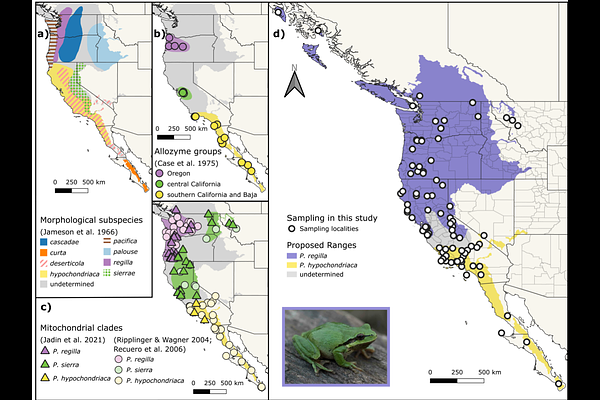
AbstractSpecies represent a fundamental unit of biodiversity in evolutionary biology, but the nature of the speciation continuum and inadequate sampling of organisms with broad distributions provide substantial challenges to species delimitation. The Pacific Treefrog complex (Pseudacris regilla sensu lato) is an iconic but systematically poorly understood group of chorus frogs inhabiting a vast portion of western North America. Current studies tentatively recognize three species in this complex (P. hypochondriaca, P. regilla, P. sierra), but disagreement remains among morphological, mitochondrial, and nuclear genetic data. In this study, we used thorough geographic sampling and thousands of nuclear loci to clarify the phylogenetic relationships and divergence history of P. regilla s.l. lineages and recommend a new taxonomic arrangement. We inferred recent divergence with gene flow between P. regilla and P. sierra, topological inconsistencies, and genealogical divergence indices that place P. regilla and P. sierra firmly in the "gray zone" of speciation. Pseudacris hypochondriaca diverged over 0.5 Ma without gene flow until recent secondary contact with the "north" (P. regilla + P. sierra) lineage. Based on inferences from our genomic data and recently published acoustic signal differentiation, we propose a two species taxonomy for this complex, recognizing the "north" lineage as P. regilla. Our study shows how extensive geographic sampling, high-throughput sequencing, and multiple analytical approaches can resolve systematic uncertainties in challenging species complexes.