Systematic assessment of disk truncation in the black hole X-ray binary Swift J1727.8-1613 using NICER

Systematic assessment of disk truncation in the black hole X-ray binary Swift J1727.8-1613 using NICER
Ole König, James F. Steiner, Niek Bollemeijer, Riley M. T. Connors, Thomas Dauser, Michal Dovčiak, Ningyue Fan, Javier A. García, David Horn, Adam Ingram, Matteo Lucchini, Guglielmo Mastroserio, Cal Miller, Edward Nathan, Michael A. Nowak, Katja Pottschmidt, Ron Remillard, Yujia Song, Jiří Svoboda, Michiel van der Klis, Santiago Ubach, Jörn Wilms, Yuexin Zhang
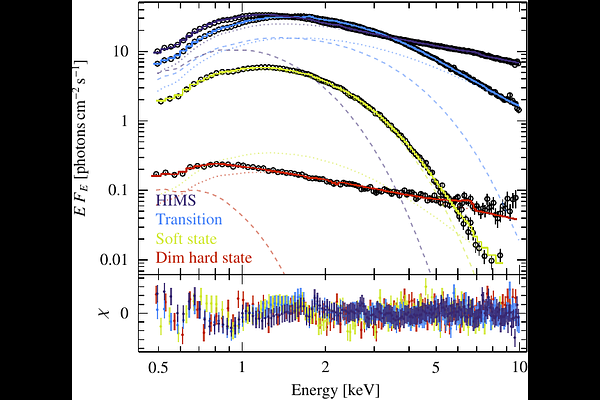
AbstractThe 2023/24 NICER monitoring campaign of the 7 Crab bright black hole X-ray binary Swift J1727.8-1613 covered the outburst in almost all accretion states. High-quality data are available in the high-Eddington-fraction hard-intermediate state, hard-to-soft transition, the soft state, and the poorly studied back-transition to the dim hard state, making it an ideal dataset to compare the accretion flow at vastly different accretion rates. We apply disk continuum fitting techniques to investigate the evolution of the inner disk radius throughout the outburst. Taking a temperature-dependent color-correction factor into account, we see evolution of the disk inner radius by a factor of a few comparing the hard states to the thermal/soft state. We tentatively detect an onset of disk truncation in the soft-to-hard transition, right after the source leaves the soft state. After accounting for model systematics, we find the disk to be more truncated in the high-luminosity bright hard state compared to the low-luminosity dim hard state.