Constraining the PeV gamma-ray emission zone of Cygnus X-3 with contemporaneous GeV timing and spectral observations

Constraining the PeV gamma-ray emission zone of Cygnus X-3 with contemporaneous GeV timing and spectral observations
Xing-Fu Zhang, Ruo-Yu Liu, Dmitriy Khangulyan, Cui-Yuan Dai, Xiang-Yu Wang
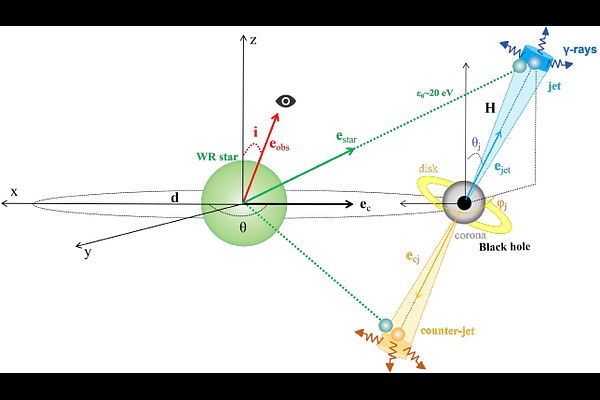
AbstractCygnus X-3 has recently been established as a variable ultra-high-energy(UHE) gamma-ray source with photons detected up to 3.7~PeV. The temporal correlation between its PeV activity and GeV flares, together with the possible orbital modulation, suggests that the emission is produced within or close to the binary system. In this work, we test whether the contemporaneous GeV emission zone can also host the acceleration of the parent protons responsible for the multi-PeV photons. We jointly model the contemporaneous \textit{Fermi}-LAT spectrum and orbital light curve with a one-zone leptonic scenario dominated by anisotropic external inverse-Compton scattering. The fit places the GeV emission region at $H\sim2.8\times10^{11}\,$cm and constrains the magnetic field--size product to $BH\lesssim10^{13.3}\,$G\,cm at the $3σ$ level. This implies a maximum proton energy of only $\sim0.3$~PeV from the Hillas criterion, far below that required by the observed PeV emission. We therefore conclude that the GeV zone cannot be the main PeV acceleration site. Instead, the PeV emission should originate from a more compact inner region, and the jet magnetic field must dissipate rapidly between the PeV and GeV emitting zones.