AI for Fisheries Science: Neural Network Tools for Forecasting, Spatial Standardization, and Policy Optimization

AI for Fisheries Science: Neural Network Tools for Forecasting, Spatial Standardization, and Policy Optimization
Kapur, M.; Adams, G.; Lapeyrolerie, M.; Thorson, J. T.
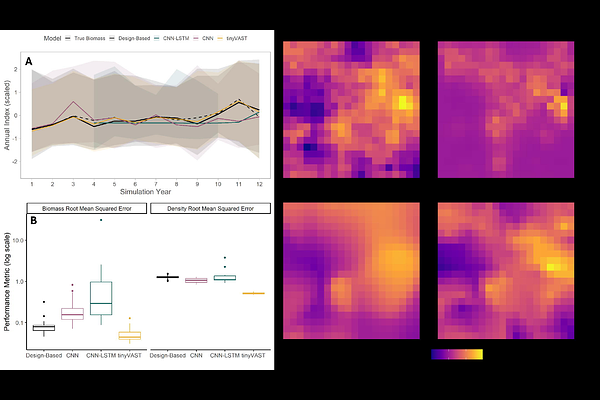
AbstractThe development of Artificial Intelligence (AI) presents novel opportunities for tackling complex marine resource management challenges. Among AI models, neural networks are a powerful class of tools capable of learning nonlocal and lagged patterns from fisheries data as well as approximating nonlinear relationships among multiple latent variables using estimation methods that automatically implement statistical shrinkage. This gives them potential to effectively handle data obtained from fisheries populations subject to dynamic environments. We highlight two flexible subclasses and one application of neural networks: Long Short-Term Memory (LSTM) and Convolutional Neural networks (CNNs) and policy discovery via Reinforcement Learning. LSTMs are designed to handle sequential data by allowing prediction from past values at both short and long time-lags. CNNs are not explicitly designed to handle temporal information, but can interpolate a spatial latent variable based on its value within a geographic neighborhood, and can be combined with LSTM models for this purpose. This "Food for Thought" paper introduces and applies these neural network approaches, both alone and in combination, to demonstrate their potential application for several foundational topics in fisheries science: 1) the forecasting of population weight-at-age, 2) the standardization of spatio-temporal indices of relative abundance, and 3) the discovery of harvest policies to optimize catches and maintain spawning biomass. Each section provides a simple, simulated example and describes the tradeoffs, particularly the lack of inferential capability, presented by using neural networks over traditional approaches for each topic. We then outline medium-term research questions that may clarify, facilitate or qualify the applicability of these tools to fisheries management science. Finally, we discuss how future combinations of these approaches could result in simplified ways to estimate and forecast stock biomass and provide harvest advice.