Predominant tetraploidy and lack of ploidy-associated genetic structure across invasive Lantana camara populations in India

Predominant tetraploidy and lack of ploidy-associated genetic structure across invasive Lantana camara populations in India
Praveen, P.; Ramakrishnan, U.
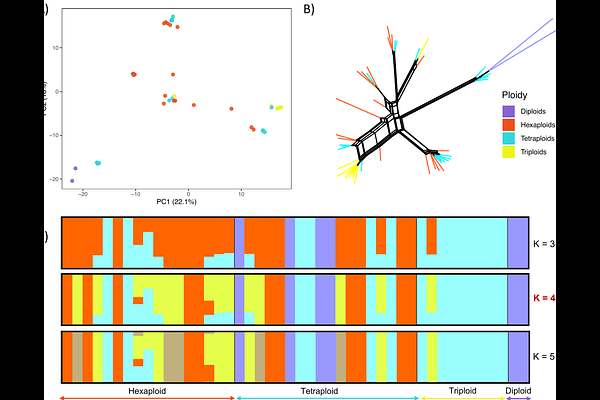
AbstractPolyploidization is widely recognised as a major driver of plant diversification, with many species persisting as mixed-ploidy systems where multiple cytotypes co-exist. Polyploids are disproportionately represented among invasive species, yet their role in facilitating biological invasions remains poorly understood. Lantana camara, one of the world's most successful invasive plants, exhibits remarkable cytotype diversity, but the distribution and evolutionary relationships of these cytotypes in its native and invasive ranges have remained unclear. Here, we characterise ploidy variation and assess the genetic differentiation among cytotypes in invasive L. camara populations across India. Flow cytometry of more than a thousand individuals reveals that tetraploids overwhelmingly dominate the invasive range, accounting for more than 95% of individuals, while triploids and hexaploids occur at much lower frequencies. Using genome-wide ddRAD-derived SNP markers from diploids, triploids, tetraploids, and hexaploids, we find no genetic differentiation among cytotypes. Instead, individuals of different ploidy levels cluster together across multiple genetic clusters, consistent with recurrent and potentially independent origins of polyploids. These patterns further suggest that L. camara polyploids likely arise via autopolyploid formation. Together, our results establish tetraploidy as the predominant cytotype in India's invasive populations and reveal a lack of cytotype-specific genetic structure. These findings highlight the need to investigate the ecological advantages of tetraploids and the mechanisms that generate cytotype diversity, key steps toward understanding how polyploidy contributes to the invasive success of this globally important species.