All for one or one for all? Disentangling the Juncus bufonius complex through morphometrics, cytometry and genomics

All for one or one for all? Disentangling the Juncus bufonius complex through morphometrics, cytometry and genomics
Williams-Marland, B.; Berjano, R.; Tremetsberger, K.; Rowntree, J.; Sanchez Garcia, R.; van Leeuwen, C. H. A.; Green, A. J.; Ortiz, M. A.
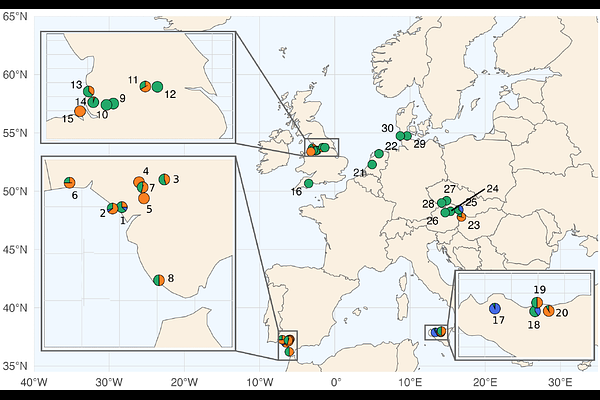
AbstractJuncus bufonius L. s.l. is a species complex with several ploidy levels, for which species delimitation remains unclear due to a lack of reliable morphological characters and the paucity of molecular studies. To clarify taxonomic and geographic relationships in the complex, we combined genomic, cytometric and morphological data from a broad latitudinal range from England down to Spain. We collected morphometric and cytometric data from 31 populations, and genomic data were obtained through Hyb-Seq using the Angiosperm353 kit for a subset of individuals. These three datasets were combined to explore phylogenetic relationships, population structure, and the validity of four previously proposed morphospecies (J. bufonius s.str., a hexaploid; J. minutulus, a tetraploid; and J. ranarius and J. hybridus, both diploids). Sequencing supported the separation of diploids and polyploids as two distinct taxa, but morphometric characters used previously to describe morphospecies showed continuous variation with no diagnostic value, and were not congruent with genomic and cytometric data. Polyploids likely originated through allopolyploidisation from diploids and tetraploids. Phylogenetic lineages were extensively mixed geographically, both for diploid and polyploid taxa, which suggests repeated long-distance dispersal events for both diploids and polyploids, and no separation of taxa by geography. Splitting of diploids into J. ranarius and J. hybridus was not supported. We recommend J. ranarius be treated as a synonym of J. hybridus, and that tetraploids and hexaploids be grouped under J. bufonius. The observed geographical patterns are consistent with high rates of seed dispersal by migratory waterbirds.