SpyTag-Enabled Assembly of Bacterial Microcompartment Trimers into Macroscopic Layered Protein Materials

SpyTag-Enabled Assembly of Bacterial Microcompartment Trimers into Macroscopic Layered Protein Materials
Wang, Y.; Zuo, X.; Wang, Y.; Ashby, P. D.; Hausinger, R. P.
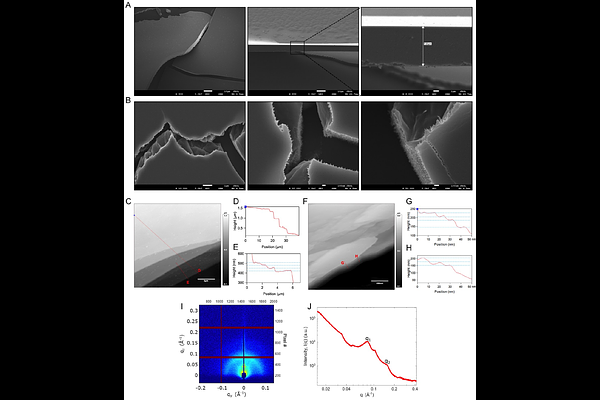
AbstractProtein self-assembly enables precise nanoscale organization but rarely translates into macroscopic materials that retain functionality beyond aqueous environments. Here, we report that a bacterial microcompartment (BMC) trimer fused with SpyTag (T1-SpyTag), when expressed as a standalone component, undergoes rapid and spontaneous self-assembly into macroscopically visible fibers and layered sheets. These structures span from the nanoscale to the millimeter scale, forming robust three-dimensional protein materials that remain structurally intact and functionally accessible in both solution and dried states. Unlike previously reported SpyTag-enabled BMC systems that function primarily as passive cargo-loading modules, T1-SpyTag macromolecular structures exhibit emergent material behavior, including chemical robustness under denaturing conditions, while preserving covalent reactivity toward SpyCatcher-fused cargos. The multilayered architecture enables tunable surface display, access to ultrathin, processable protein films, and surface renewability through layer-by-layer removal and regeneration. This work demonstrates how a minimal genetic modification of a native protein building block can drive the formation of functional, macroscopic protein materials, thus expanding the design space of BMC-derived assemblies for biointerfaces, catalysis, and sustainable protein materials engineering.